
|
You entered: apod
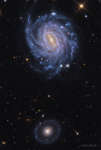 APOD: 2026 May 26 Б NGC 3660 and Burcins Galaxy
26.05.2026
The upper galaxy might be more photogenic, but the lower galaxy is more unusual. The galaxy up top is NGC 3660, a spiral galaxy similar to our own Milky Way galaxy in that it has several bright blue spiral arms and a central bar of stars, dust, and gas.
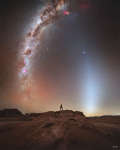 APOD: 2026 July 6 Б Dueling Bands over the Atacama Desert
6.07.2026
What are these two bands in the sky? The more commonly seen band is on the left and is the central band of our Milky Way galaxy. Our Sun orbits in the disk of this spiral galaxy so that from inside, it appears as a band of comparable brightness all the way around the sky.
 APOD: 2023 September 5 Б Blue Supermoon Beyond Syracuse
5.09.2023
The last full moon was doubly unusual. First of all, it was a blue moon. A modern definition of a blue moon is a second full moon to occur during one calendar month. Since there are 13 full moons in 2023, one month has to have two -- and that month was August.
 APOD: 2023 November 12 Б Gibbous Moon beyond Swedish Mountain
12.11.2023
This is a gibbous Moon. More Earthlings are familiar with a full moon, when the entire face of Luna is lit by the Sun, and a crescent moon, when only a sliver of the Moon's face is lit.
 APOD: 2023 May 14 Б To Fly Free in Space
14.05.2023
What would it be like to fly free in space? At about 100 meters from the cargo bay of the space shuttle Challenger, Bruce McCandless II was living the dream -- floating farther out than anyone had ever been before. Guided by a Manned Maneuvering Unit (MMU), astronaut McCandless, pictured, was floating free in space.
 APOD: 2025 July 31 Б Supernova 2025rbs in NGC 7331
31.07.2025
A long time ago in a galaxy 50 million light-years away, a star exploded. Light from that supernova was first detected by telescopes on planet Earth on July 14th though, and the extragalactic transient is now known to astronomers as supernova 2025rbs.
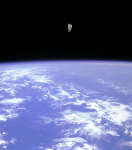 APOD: 2026 February 15 Б To Fly Free in Space
15.02.2026
What would it be like to fly free in space? About 100 meters from the cargo bay of a space shuttle, Bruce McCandless II was living the dream -- floating farther out than anyone had ever been before. Guided by a Manned Maneuvering Unit (MMU), astronaut McCandless, pictured, was floating free in space.
 APOD: 2026 July 9 Б The Red Glow of the Cosmic Bat Nebula
9.07.2026
This Cosmic Bat wishes you a happy Summerween! This mid-year celebration of Halloween transcends hemispheres, even though summer in the Northern hemisphere is winter in the South. Contrary to its eery aura, the Cosmic Bat Nebula (LDN 43), not to be confused with the Bat Nebula (NGC 6995), is a vibrant birthplace for stars.
 APOD: 2024 March 13 Б The Seagull Nebula
13.03.2024
A broad expanse of glowing gas and dust presents a bird-like visage to astronomers from planet Earth, suggesting its popular moniker: the Seagull Nebula. This portrait of the cosmic bird covers a 1.6-degree...
 APOD: 2023 August 23 Б The Meteor and the Galaxy
23.08.2023
It came from outer space. It -- in this case a sand-sized bit of a comet nucleus -- was likely ejected many years ago from Sun-orbiting Comet Swift-Tuttle, but then continued to orbit the Sun alone.
|
January February March April May June July August September |
|||||||||||||||||||||||||||||||||||||||||||||||||