
|
You entered: camera
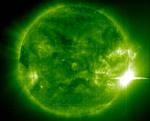 Flare Well AR 10486
6.11.2003
Almost out of view from our fair planet, rotating around the Sun's western edge, giant sunspot region AR 10486 lashed out with another intense solar flare followed by a large coronal mass ejection (CME) on Tuesday, November 4th at about 1950 Universal Time.
 Southern Cross Star Colors
8.07.2004
Fix your camera to a tripod, lock the shutter open, and you can easily record an image of star trails, the graceful concentric arcs traced by the stars as planet Earth rotates on its axis.
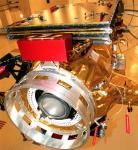 Full Throttle For Deep Space 1
31.08.2000
At full throttle the Deep Space 1 spacecraft's innovative ion drive produces about 1/50th of a pound of thrust ... a force so great that it would just about hold up a piece of paper on planet Earth! Still, powered by solar arrays ion propulsion systems can run continuously.
 Distortion from a Distant Cluster
23.08.2001
This stunning color deep sky view toward the constellation Pisces was made with data from a fast, sensitive, digital detector known as the Big Throughput Camera operating at Cerro Tololo Inter-American Observatory in Chile.
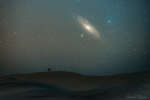 Andromeda over Patagonia
25.11.2020
How far can you see? The Andromeda Galaxy at 2.5 million light years away is the most distant object easily seen with your unaided eye. Most other apparent denizens of the night sky -- stars...
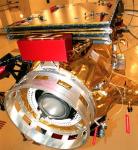 Full Throttle For Deep Space 1
22.09.2001
At full throttle the Deep Space 1 spacecraft's innovative ion drive produces about 1/50th of a pound of thrust ... a force so great that it would just about hold up a piece of paper on planet Earth! Still, powered by solar arrays ion propulsion systems can run continuously.
 APOD: 2023 November 8 Б Perseus Galaxy Cluster from Euclid
8.11.2023
There's a new space telescope in the sky: Euclid. Equipped with two large panoramic cameras, Euclid captures light from the visible to the near-infrared. It took five hours of observing for Euclid...
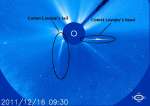 Comet Lovejoy: Sungrazing Survivor
17.12.2011
Like most other sungrazing comets, Comet Lovejoy (C/2011 W3) was not expected to survive its close encounter with the Sun. But it did. This image from a coronograph onboard the sun-staring SOHO spacecraft identifies the still inbound remnants of the tail, with the brilliant head or coma emerging from the solar glare on December 16.
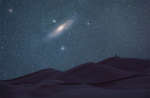 Andromeda over the Sahara Desert
11.07.2022
What is the oldest thing you can see? At 2.5 million light years distant, the answer for the unaided eye is the Andromeda galaxy, because its photons are 2.5 million years old when they reach you.
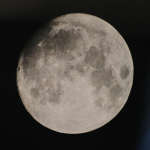 21st Century Wet Collodion Moon
2.01.2021
In the mid 19th century, one of the first photographic technologies used to record the lunar surface was the wet-plate collodion process, notably employed by British astronomer Warren De la Rue. To capture...
|
January February March April May June July August |
||||||||||||||||||||||||||||||||||||||||||||||||||||||||