
|
You entered: color
 APOD: 2023 July 24 Б Chemicals Glow as a Meteor Disintegrates
24.07.2023
Meteors can be colorful. While the human eye usually cannot discern many colors, cameras often can. Pictured here is a fireball, a disintegrating meteor that was not only one of the brightest the photographer has ever seen, but colorful.
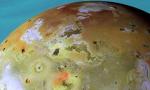 Sizzling Io
6.07.1998
What's cooking on Io? This active moon of Jupiter is marked with volcanoes spewing lava that is now known to be hotter than any lava on Earth. Above is the highest resolution color-enhanced image yet composed of the most active surface in our Solar System. Features as small as three kilometers are visible.
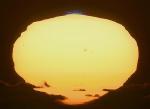 Blue Flash
9.01.2002
Difficult to observe, the momentary green flash above the rising or setting sun has been documented as a phenomenon caused by the atmospheric bending or refraction of sunlight. Like a weak prism, the Earth's atmosphere breaks white sunlight into colors, bending red colors slightly and green and blue colors through increasingly larger angles.
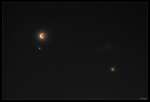 Spica, Mars, and Eclipsed Moon
16.04.2014
A beautiful, reddened Moon slid through dark skies on April 15, completely immersed in Earth's shadow for well over an hour. It was the year's first total lunar eclipse and was widely enjoyed over the planet's Western Hemisphere.
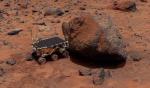 Mars Rocks, Sojourner Rolls
30.10.1999
This sharp color image featuring Mars rock Yogi and the rolling Sojourner robot shows off Yogi's two-toned surface. Yogi appears to be leaning into the prevailing winds causing some to suggest that its color contrast may be caused by the accumulation of rust colored dust on its windward face.
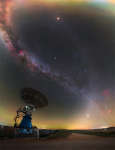 APOD: 2025 November 3 Б A Double Helix Lunar Eclipse
3.11.2025
The image was timed to capture a total lunar eclipse -- but it came with quite a twist. First, the eclipse: the fully Earth-shadowed Moon is visible as the orange orb near the top.
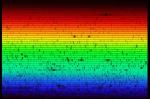 The Solar Spectrum
23.04.2006
It is still not known why the Sun's light is missing some colors. Shown above are all the visible colors of the Sun, produced by passing the Sun's light through a prism-like device.
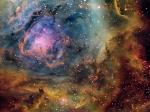 The Busy Center of the Lagoon Nebula
3.08.2005
Stars are battling gas and dust in the Lagoon Nebula but the photographers are winning. Also known as M8, this photogenic nebula is visible even without binoculars towards the constellation of Sagittarius. The energetic processes of star formation create not only the colors but the chaos.
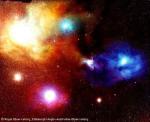 Antares and Rho Ophiuchi
9.05.2004
Why is the sky near Antares and Rho Ophiuchi so colorful? The colors result from a mixture of objects and processes. Fine dust illuminated from the front by starlight produces blue reflection nebulae. Gaseous clouds whose atoms are excited by ultraviolet starlight produce reddish emission nebulae. Backlit dust clouds block starlight and so appear dark.
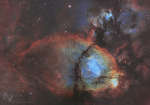 IC 1795: The Fishhead Nebula
23.12.2014
To some, this nebula looks like the head of a fish. However, this colorful cosmic portrait really features glowing gas and obscuring dust clouds in IC 1795, a star forming region in the northern constellation Cassiopeia.
|
January February March April May June July August September October |
|||||||||||||||||||||||||||||||||||||||||||||||||