
|
You entered: dark matter
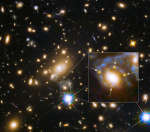 Galaxy and Cluster Create Four Images of Distant Supernova
8.03.2015
What are the unusual spots surrounding that galaxy? They are all images of the same supernova. For the first time, a single supernova explosion has been seen split into multiple images by the gravitational lens deflections of intervening masses. In this case the masses are a large galaxy and its home galaxy cluster.
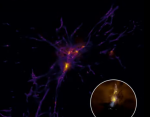 Simulation: Formation of the First Stars
30.06.2021
How did the first stars form? To help find out, the SPHINX computer simulation of star formation in the very early universe was created, some results of which are shown in the featured video. Time since the Big Bang is shown in millions of years on the upper left.
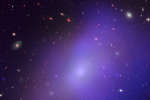 Elliptical Galaxy NGC 1132
13.02.2008
NGC 1132 is one smooth galaxy -- but how did it form? As an elliptical galaxy, NGC 1132 has little dust and gas, and few stars have formed in it recently. Although many elliptical galaxies are in clusters of galaxies, NGC 1132 appears as a large, isolated galaxy toward the constellation of the River (Eridanus).
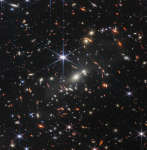 Webb s First Deep Field
13.07.2022
This is the deepest, sharpest infrared image of the cosmos so far. The view of the early Universe toward the southern constellation Volans was achieved in 12.5 hours of exposure with the NIRCam instrument on the James Webb Space Telescope. Of course the stars with six visible spikes are well within our own Milky Way.
 Giant Cluster Bends, Breaks Images
14.06.1998
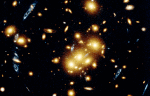
What are those strange blue objects? Many are images of a single, unusual, beaded, blue, ring-like galaxy which just happens to line-up behind a giant cluster of galaxies. Cluster galaxies here appear yellow and -- together with the cluster's dark matter -- act as a gravitational lens.
 Giant Cluster Bends, Breaks Galaxy Images
3.05.1997
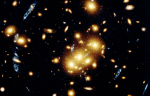
What are those strange blue objects? Many are images of a single, unusual, beaded, blue, ring-like galaxy which just happens to line-up behind a giant cluster of galaxies. Cluster galaxies here appear yellow and -- together with the cluster's dark matter -- act as a gravitational lens.
 The Milky Way's Gamma-Ray Halo
5.11.1997
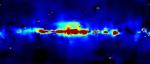
Our Milky Way galaxy appears to be surrounded by a halo of gamma rays. Gamma rays are the most energetic form of electromagnetic radiation, with more than a hundred thousand times the energy of visible light, but known gamma-ray sources don't account for the diffuse distribution of this high-energy glow.
 HESS Telescopes Explore the High Energy Sky
8.01.2019
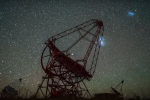
They may look like modern mechanical dinosaurs but they are enormous swiveling eyes that watch the sky. The High Energy Stereoscopic System (H.E.S.S.) Observatory is composed of four 12-meter reflecting-mirror telescopes surrounding a larger telescope housing a 28-meter mirror.
 Small Star
5.06.1997
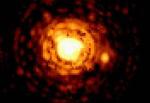
A dim double star system cataloged as Gliese 623 lies 25 light-years from Earth, in the constellation of Hercules. The individual stars of this binary system were distinguished for the first time when the Hubble Space Telescope's Faint Object Camera recorded this image in June 1994.
 Webb's First Deep Field
15.07.2023
This stunning infrared image was released one year ago as the James Webb Space Telescope began its exploration of the cosmos. The view of the early Universe toward the southern constellation Volans was achieved in 12.5 hours of exposure with Webb's NIRCam instrument.
|
January February March April May June July August September October |
|||||||||||||||||||||||||||||||||||||||||||||||||