
|
You entered: interacting galaxies
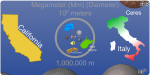 The Scale of the Universe Interactive
7.10.2018
What does the universe look like on small scales? On large scales? Humanity is discovering that the universe is a very different place on every proportion that has been explored. For example, so far as we know, every tiny proton is exactly the same, but every huge galaxy is different.
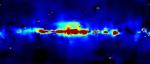 The Milky Way's Gamma-Ray Halo
5.11.1997
Our Milky Way galaxy appears to be surrounded by a halo of gamma rays. Gamma rays are the most energetic form of electromagnetic radiation, with more than a hundred thousand times the energy of visible light, but known gamma-ray sources don't account for the diffuse distribution of this high-energy glow.
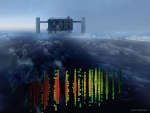 Distant Neutrinos Detected Below Antarctic Ice
1.09.2015
From where do these neutrinos come? The IceCube Neutrino Observatory near the South Pole of the Earth has begun to detect nearly invisible particles of very high energy. Although these rarely-interacting neutrinos pass through much of the Earth just before being detected, where they started remains a mystery.
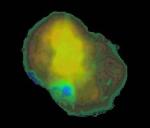 X-Rays From IC 443
2.05.1997
The life-cycles of stars help drive the ecology of our Galaxy, churning, processing, and redistributing matter. Massive stars reach a spectacular evolutionary endpoint - supernovae explosions which blast off their outer layers, violently merging stellar material with the gas and dust of the Milky Way. The supernova remnant IC 443 is typical of the aftermath.
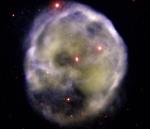 NGC 246 and the Dying Star
18.04.2006
Appropriately nicknamed "the Skull Nebula", planetary nebula NGC 246 really does surround a dying star some 1,600 light-years away in the constellation Cetus. Expelled over a period of thousands of years, the lovely, intricate nebula is the outer atmosphere of a once sun-like star.
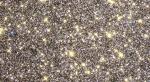 The Center of Globular Cluster Omega Centauri
10.10.2001
What is left over after stars collide? To help answer this question, astronomers have been studying the center of the most massive ball of stars in our Milky Way Galaxy. In the center of globular cluster Omega Centauri, stars are packed in 10,000 times more densely than near our Sun.
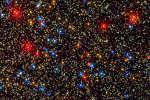 The Center of Globular Cluster Omega Centauri
14.09.2009
What is left over after stars collide? To help answer this question, astronomers have been studying the center of the most massive ball of stars in our Milky Way Galaxy. In the center of globular cluster Omega Centauri, stars are packed in 10,000 times more densely than near our Sun.
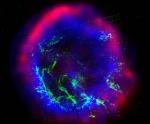 Supernova Remnant E0102 72 from Radio to X-Ray
14.04.2000
Not all stars form a big Q after they explode. The shape of supernova remnant E0102-72, however, is giving astronomers a clue about how tremendous explosions disperse elements and interact with surrounded gas. The above image is a composite of three different photographs in three different types of light.
 XMM-Newton First Light: X-Rays From The LMC
11.02.2000
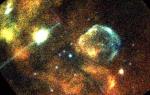
Recently the European Space Agency released this and other spectacular "first light" pictures from its new orbiting x-ray observatory, christened XMM-Newton. A churning region of star birth and death in our small neighboring galaxy, the Large Magellanic Cloud (LMC), this field was one of several chosen to test out XMM-Newton's x-ray imaging capabilities.
 Neutrinos in the Sun
5.06.1998
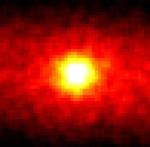
Neutrinos, along with things like electrons and quarks, are fundamental pieces of matter according to physicists' Standard Model. But neutrinos are hard to detect. Readily produced in nuclear reactions and particle collisions, they can easily pass completely through planet Earth without once interacting with any other particle.
|
January February March April May June July August September October |
|||||||||||||||||||||||||||||||||||||||||||||||||