
|
You entered: neutron star
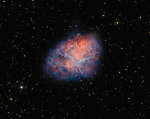 M1: The Crab Nebula
20.11.2014
The Crab Nebula is cataloged as M1, the first object on Charles Messier's famous 18th century list of things which are not comets. In fact, the Crab is now known to be a supernova remnant, debris from the death explosion of a massive star, witnessed by astronomers in the year 1054.
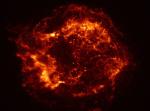 Chandras First Light: Cassiopeia A
27.08.1999
Cosmic wreckage from the detonation of a massive star is the subject of this official first image from NASA's Chandra X-ray Observatory. The supernova remnant, known as Cassiopeia A, was produced when a star exploded around 300 years ago in this northern sky constellation.
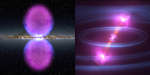 Fermi Science Finals
23.07.2018
The Fermi Science Playoffs celebrate 10 years of the Fermi Gamma-ray Space Telescope's exploration of the high-energy universe. Surviving all early rounds of voting, these two finalists in the competion square off at last.
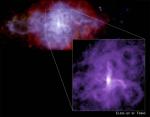 3C58: Pulsar Power
23.12.2004
Light from a star that exploded some ten thousand light-years away first reached our fair planet in the year 1181. Now known as supernova remnant 3C58, the region seen in this false-color image glows in x-rays, powered by a rapidly spinning neutron star or pulsar - the dense remains of the collapsed stellar core.
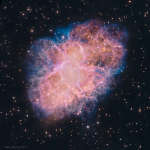 M1: The Crab Nebula
24.12.2021
The Crab Nebula is cataloged as M1, the first object on Charles Messier's famous 18th century list of things which are not comets. In fact, the Crab is now known to be a supernova remnant, debris from the death explosion of a massive star, witnessed by astronomers in the year 1054.
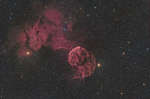 Sharpless 249 and the Jellyfish Nebula
23.03.2018
Normally faint and elusive, the Jellyfish Nebula is caught in this alluring telescopic image. Centered in the scene it's anchored right and left by two bright stars, Mu and Eta Geminorum, at the foot of the celestial twin. The Jellyfish Nebula is the brighter arcing ridge of emission with dangling tentacles.
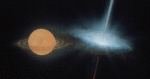 Jets From SS433
6.03.1996
SS433 is one of the most exotic star systems known to astronomers. Its unremarkable name stems from its inclusion in a catalog of stars which emit radiation characteristic of atomic hydrogen. Its very remarkable behavior stems from a compact object, a black hole or neutron star, which has produced an accretion disk with jets.
 APOD: 2026 March 26 Б
26.03.2026
What is the sound of two black holes merging in deep space? Sound waves don't propagate in vacuum, but gravitational waves do. In 2015 we were able to "hear" them for the first time and confirm one of Albert Einstein's theoretical predictions.
 X-Rays From Antennae Galaxies
18.08.2000
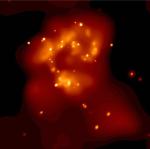
A bevy of black holes and neutron stars shine as bright, point-like sources against bubbles of million degree gas in this false-color x-ray image from the orbiting Chandra Observatory. The striking picture shows...
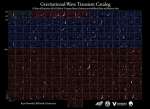
 Ninety Gravitational Wave Spectrograms and Counting
7.12.2021
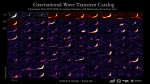
Every time two massive black holes collide, a loud chirping sound is broadcast out into the universe in gravitational waves. Humanity has only had the technology to hear these unusual chirps for the past seven years, but since then we have heard about 90 -- during the first three observing runs.
|
January February March April May June July August September October |
|||||||||||||||||||||||||||||||||||||||||||||||||