
|
You entered: north star
 APOD: 2023 August 7 Б The Pelican Nebula in Gas, Dust, and Stars
7.08.2023
The Pelican Nebula is slowly being transformed. IC 5070 (the official designation) is divided from the larger North America Nebula by a molecular cloud filled with dark dust. The Pelican, however, receives much study because it is a particularly active mix of star formation and evolving gas clouds.
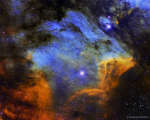 The Pelican Nebula in Gas Dust and Stars
17.11.2015
The Pelican Nebula is slowly being transformed. IC 5070, the official designation, is divided from the larger North America Nebula by a molecular cloud filled with dark dust. The Pelican, however, receives much study because it is a particularly active mix of star formation and evolving gas clouds.
 Comet and Meteor
5.01.2009
This meteor streaking toward the horizon through the early morning sky of January 3rd is from the annual Quadrantid meteor shower. Aligned with the shower's radiant point high in the north (off the top of the view), the meteor trail passes to the right of bright bluish star Beta Scorpii.
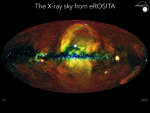 The X Ray Sky from eROSITA
23.06.2020
What if you could see X-rays? The night sky would seem a strange and unfamiliar place. X-rays are about 1,000 times more energetic than visible light photons and are produced by violent explosions and high temperature astronomical environments.
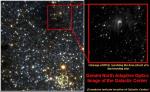 Gemini North Images Bow Shock Near Galactic Center
17.10.2000
What's going on near the center of our Galaxy? Glowing across the electromagnetic spectrum, the center of our Milky Way Galaxy is thought to be home to massive stars, rotating gas rings, and a massive black hole. Now the central Galactic zoo just got larger.
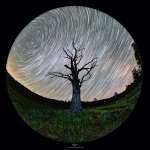 Roots on a Rotating Planet
8.07.2022
With roots on a rotating planet, an old tree is centered in this sequence of 137 exposures each 20 seconds long, recorded one night from northern Sicily. Digital camera and fisheye lens were fixed to a tripod to capture the dramatic timelapse, so the stars trailed through the region's dark sky.
 Geostationary Satellites Beyond the Alps
11.04.2012
Why don't those stars move? Stars in the sky will typically appear to rise and set as the Earth turns. Those far to the north or south will appear to circle the pole. If you look closely at the above time-lapse movie, however, there are points of light that appear stationary.
 A Radio Vista of Cygnus
18.02.2002
Shells of ancient supernovas, cocoons surrounding newborn stars, and specks from distant quasars highlight this tremendous vista toward the constellation of Cygnus. The representative color image covers about 10 degrees across on the sky but is only a small part of the Canadian Galactic Plane Survey in radio light.
 The Milky Way Sets
26.08.2016
Under dark skies the setting of the Milky Way can be a dramatic sight. Stretching nearly parallel to the horizon, this rich, edge-on vista of our galaxy above the dusty Namibian desert stretches from bright, southern Centaurus (left) to Cepheus in the north (right).
 Alphonsus and Arzachel
17.07.2021
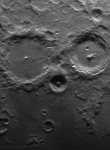
Point your telescope at tonight's first quarter Moon. Along the terminator, the shadow line between night and day, you might find these two large craters staring back at you with an owlish gaze. Alphonsus (left) and Arzachel are ancient impact craters on the north eastern shores of Mare Nubium, the lunar Sea of Clouds.
|
January February March April May June July August |
||||||||||||||||||||||||||||||||||||||||||||||||||||||||