
|
You entered: red dwarf
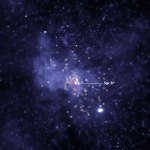 A Plurality of Singularities at the Galactic Center
12.05.2018
A recent informal poll found that astronomers don't yet have a good collective noun for a group of black holes, but they need one. The red circles in this Chandra Observatory X-ray image identify a group of a dozen black holes that are members of binary star systems.
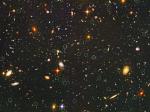 HUDF: Dawn of the Galaxies
29.09.2004
When did galaxies form? Faint red smudges identified on the deepest optical sky image ever taken may well be members of the first class of galaxies. Detailed inspection of the Hubble Ultra Deep Field...
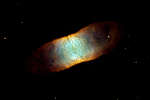 IC 4406: A Seemingly Square Nebula
27.07.2008
How can a round star make a square nebula? This conundrum comes to light when studying planetary nebulae like IC 4406. Evidence indicates that IC 4406 is likely a hollow cylinder, with its square appearance the result of our vantage point in viewing the cylinder from the side.
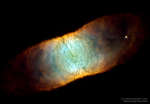 IC 4406: A Seemingly Square Nebula
8.01.2017
How can a round star make a square nebula? This conundrum comes to light when studying planetary nebulae like IC 4406. Evidence indicates that IC 4406 is likely a hollow cylinder, with its square appearance the result of our vantage point in viewing the cylinder from the side.
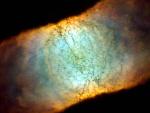 IC 4406: A Seemingly Square Nebula
18.06.2002
How can a round star make a square nebula? This conundrum comes to light when studying planetary nebulae like IC 4406. Evidence indicates that IC 4406 is likely a hollow cylinder, with its square appearance the result of our vantage point in viewing the cylinder from the side.
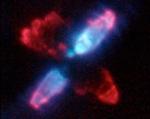 Shells in the Egg Nebula
20.05.1997
The Egg Nebula is taking a beating. Like a baby chick pecking its way out of an egg, the star in the center of the Egg Nebula is casting away shells of gas and dust as it slowly transforms itself into a white dwarf star.
 SNR 0104: An Unusual Suspect
12.06.2009
SNR 0104 is a supernova remnant with an unusual shape. Found 190,000 light-years away in our neighboring galaxy the Small Magellanic Cloud, SNR 0104 is suspected of being the expanding debris cloud from a Type 1a supernova - the catastrophic thermonuclear explosion of a white dwarf star.
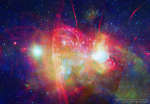 The Galactic Center from Radio to X ray
31.03.2020
In how many ways does the center of our Galaxy glow? This enigmatic region, about 26,000 light years away toward the constellation of the Archer (Sagittarius), glows in every type of light that we can see.
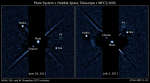 Pluto s P4
22.07.2011
Nix and Hydra were first introduced to human eyes in Hubble Space Telescope images from May 2005, as Pluto's second and third known moons. Now Hubble images have revealed a fourth satellite for the icy, dwarf planet. Provisionally designated P4, it completes an orbit of Pluto in about 31 days.
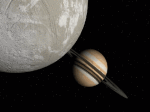 Worlds of a Distant Sun: 47 Ursae Majoris b
1.07.1996
Within the last few years, observational astronomy has given humanity evidence of the existence of worlds beyond the solar system. Indeed, solar-type stars are now inferred to harbor planets of approximately Jupiter mass - some residing in temperature zones which could conceivably support liquid water and therefore life!
|
January February March April May June July August |
||||||||||||||||||||||||||||||||||||||||||||||||||||||||