
|
You entered: total lunar eclipse
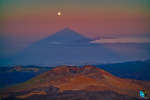 A Triangular Shadow of a Large Volcano
5.07.2011
Why does the shadow of this volcano look like a triangle? The Mount Teide volcano itself does not have the strictly pyramidal shape that its geometric shadow might suggest. The triangle shadow phenomena is not unique to the Mt. Teide, though, and is commonly seen from the tops of other large mountains and volcanoes.
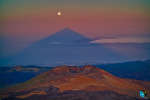 A Triangular Shadow of a Large Volcano
8.06.2019
Why does the shadow of this volcano look like a triangle? The Mount Teide volcano itself does not have the strictly pyramidal shape that its geometric shadow might suggest. The triangle shadow phenomena is not unique to the Mt. Teide, though, and is commonly seen from the tops of other large mountains and volcanoes.
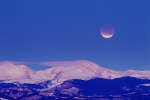 Eclipsed Moon in the Morning
24.12.2011
December's lunar eclipse graced early morning skies over the Rocky Mountains in Colorado, USA. There, this wintry scene finds the Moon in a cold blue twilight sky near the western horizon, above the snowy North American Continental Divide.
 The Protostars within Lynds 483
12.03.2025
Two protostars are hidden in a single pixel near the center of a striking hourglass-shaped nebula in this near-infrared image from the James Webb Space Telescope. The actively forming star system lies in a dusty molecular cloud cataloged as Lynds 483, some 650 light-years distant toward the constellation Serpens Cauda.
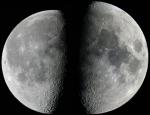 Apogee Moon, Perigee Moon
21.10.2004
Why don't these pieces fit? This third quarter Moon (left) and first quarter Moon were both photographed during the last lunar cycle or lunation with the same telescope and camera. But, simply combining the pictures into one sharp, full surface view would clearly be a problem.
 At the Sun s Edge
7.08.2008
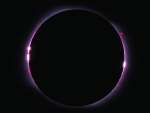
A train trip on the Trans-Siberian railway to Novosibirsk resulted in this stunning view along the edge of the Sun recorded during the August 1st total solar eclipse. The picture is a composite...
 Mars in the Loop
7.11.2018
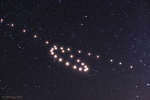
This composite of images spaced some 5 to 9 days apart, from late April (bottom right) through November 5 (top left), traces the retrograde motion of ruddy-colored Mars through planet Earth's night sky.
 ISS: Sunlight to Shadow
27.02.2008
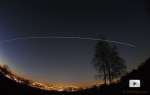
Orbiting 400,000 kilometers above the Earth, the Moon slid into Earth's shadow to begin last week's total lunar eclipse. Of course the International Space Station (ISS) slides into Earth's shadow every 90 minutes, the time it takes it to complete one orbit at an altitude of about 400 kilometers.
 Eclipsed in Southern Skies
30.09.2015
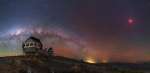
This stunning panorama in southern skies was recorded on the colorful night of September 27/28 from Carngegie Las Campanas Observatory. A diffuse glow and dark rifts of the central Milky Way hang over domes of the twin 6.5 meter Magellan telescopes. But most eye-catching is the deep red glow of the Moon.
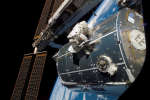 Columbus Laboratory Installed on Space Station
18.02.2008
The International Space Station (ISS) has been equipped with a powerful new scientific laboratory. The Space Shuttle Atlantis delivered the Columbus Laboratory to the ISS and installed the seven meter long module over the past week.
|
January February March April May June July August September October |
|||||||||||||||||||||||||||||||||||||||||||||||||