
|
You entered: variable star
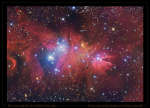 A Fox Fur, a Unicorn, and a Christmas Tree
6.04.2010
What do the following things have in common: a cone, the fur of a fox, and a Christmas tree? Answer: they all occur in the constellation of the unicorn (Monoceros). Pictured above...
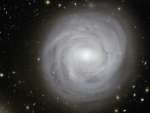 Anemic Galaxy NGC 4921 at the Edge
9.02.2009
How far away is spiral galaxy NGC 4921? Although presently estimated to be about 320 million light years distant, a more precise determination could be coupled with its known recession speed to help humanity better calibrate the expansion rate of the entire visible universe.
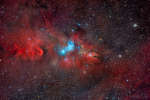 Fox Fur, Unicorn, and Christmas Tree
26.12.2020
Clouds of glowing hydrogen gas fill this colorful skyscape in the faint but fanciful constellation Monoceros, the Unicorn. A star forming region cataloged as NGC 2264, the complex jumble of cosmic gas and dust...
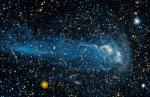 The Tail of a Wonderful Star
17.08.2007
To seventeenth century astronomers, Omicron Ceti or Mira was known as a wonderful star, a star whose brightness could change dramatically in the course of about 11 months. Mira is now seen as the archetype of an entire class of long-period variable stars.
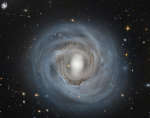 Anemic Spiral NGC 4921 from Hubble
25.11.2013
How far away is spiral galaxy NGC 4921? Although presently estimated to be about 310 million light years distant, a more precise determination could be coupled with its known recession speed to help humanity better calibrate the expansion rate of the entire visible universe.
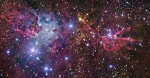 Fox Fur, a Unicorn, and a Christmas Tree
25.12.2008
Clouds of glowing hydrogen gas fill this colorful skyscape in the faint but fanciful constellation Monoceros, the Unicorn. A star forming region cataloged as NGC 2264, the complex jumble of cosmic gas and dust...
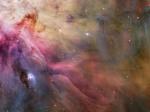 LL Ori and the Orion Nebula
20.01.2006
This esthetic close-up of cosmic clouds and stellar winds features LL Orionis, interacting with the Orion Nebula flow. Adrift in Orion's stellar nursery and still in its formative years, variable star LL Orionis produces a wind more energetic than the wind from our own middle-aged Sun.
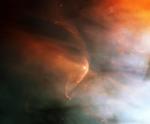 LL Orionis: When Cosmic Winds Collide
15.11.2003
This arcing, graceful structure is actually a bow shock about half a light-year across, created as the wind from young star LL Orionis collides with the Orion Nebula flow. Adrift in Orion's stellar...
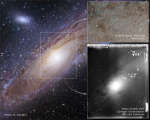 VAR
VAR
1.07.2011
In the 1920s, examining photographic plates from the Mt. Wilson Observatory's 100 inch telescope, Edwin Hubble determined the distance to the Andromeda Nebula, decisively demonstrating the existence of other galaxies far beyond the Milky Way.
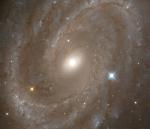 NGC 4603 and the Expanding Universe
27.05.1999
NGC 4603, a galaxy with majestic spiral arms and intricate dust lanes, is 108 million light-years away. Its distance has been accurately measured by astronomers using one of the fundamental yardsticks of the extragalactic distance scale - pulsating variable stars known as Cepheids.
|
January February March April May June July August September |
|||||||||||||||||||||||||||||||||||||||||||||||||