
|
You entered: young stars
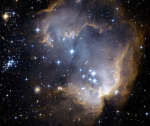 NGC 602 and Beyond
13.01.2013
Near the outskirts of the Small Magellanic Cloud, a satellite galaxy some 200 thousand light-years distant, lies 5 million year young star cluster NGC 602. Surrounded by natal gas and dust, NGC 602 is featured in this stunning Hubble image of the region.
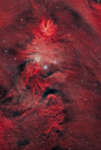 Unicorn, Fox Fur and Christmas Tree
25.12.2025
A star forming region cataloged as NGC 2264, this beautiful but complex arrangement of interstellar gas and dust is about 2,700 light-years distant in the faint but fanciful constellation Monoceros, the Unicorn. Seen...
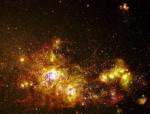 NGC 4214: Star Forming Galaxy
7.01.2000
Dazzling displays of star formation abound across the face of galaxy NGC 4214, a mere 13 million light-years away in the northern constellation Canes Venatici. While this 1997 Hubble Space Telescope image shows...
 Grand Spiral NGC 5643
26.12.2024
Viewed face-on, grand spiral galaxy NGC 5643 has a festive appearance in this colorful cosmic portrait. Some 55 million light-years distant, the galaxy extends for over 100,000 light-years, seen within the boundaries of the southern constellation Lupus.
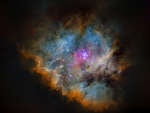 NGC 281: Starless with Stars
19.11.2021
In visible light the stars have been removed from this narrow-band image of NGC 281, a star forming region some 10,000 light-years away toward the constellation Cassiopeia. Stars were digitally added back to the resulting starless image though.
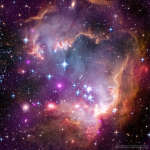 NGC 602 and Beyond
24.03.2018
Near the outskirts of the Small Magellanic Cloud, a satellite galaxy some 200 thousand light-years distant, lies 5 million year young star cluster NGC 602. Surrounded by natal gas and dust...
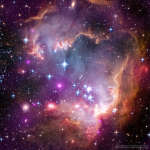 NGC 602 and Beyond
11.01.2020
Near the outskirts of the Small Magellanic Cloud, a satellite galaxy some 200 thousand light-years distant, lies 5 million year young star cluster NGC 602. Surrounded by natal gas and dust...
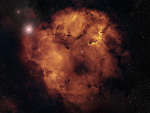 Monsters of IC 1396
25.04.2011
Is there a monster in IC 1396? Known to some as the Elephant's Trunk Nebula, parts of the glowing gas and dust clouds of this star formation region may appear to take on foreboding forms, some nearly human. The entire nebula might even look like a face of a monster.
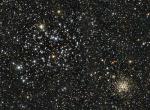 Open Star Clusters M35 and NGC 2158
29.11.2002
Open clusters of stars can be near or far, young or old, and diffuse or compact. Open clusters may contain from 100 to 10,000 stars, all of which formed at nearly the same time. Bright blue stars frequently distinguish younger open clusters.
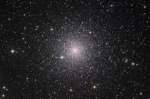 Globular Star Cluster NGC 6752
5.07.2013
Some 13,000 light-years away toward the southern constellation Pavo, the globular star cluster NGC 6752 roams the halo of our Milky Way galaxy. Over 10 billion years old, NGC 6752 follows clusters Omega Centauri and 47 Tucanae as the third brightest globular in planet Earth's night sky.
|
January February March April May June July August September October |
|||||||||||||||||||||||||||||||||||||||||||||||||