
|
You entered: Milky Way
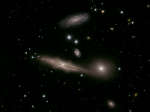 HCG 87: A Small Group of Galaxies
9.08.2015
Sometimes galaxies form groups. For example, our own Milky Way Galaxy is part of the Local Group of Galaxies. Small, compact groups, like Hickson Compact Group 87 (HCG 87) shown above, are interesting partly because they slowly self-destruct.
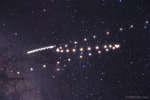 Retrograde Mars and Saturn
15.09.2016
Wandering Mars and Saturn have spent much of this year remarkably close in planet Earth's night sky. In a sequence of exposures spanning mid-December 2015 through the beginning of this week, this composited...
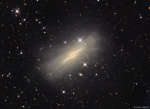 The Edge On Spindle Galaxy
25.07.2018
What kind of celestial object is this? A relatively normal galaxy -- but seen from its edge. Many disk galaxies are actually just as thin as NGC 5866, pictured here, but are not seen edge-on from our vantage point. A perhaps more familiar galaxy seen edge-on is our own Milky Way Galaxy.
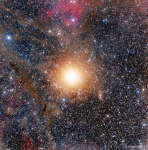 Behind Betelgeuse
11.05.2020
What's behind Betelgeuse? One of the brighter and more unusual stars in the sky, the red supergiant star Betelgeuse can be found in the direction of famous constellation Orion. Betelgeuse, however, is actually...
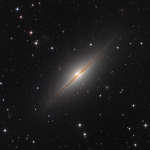 NGC 7814: Little Sombrero with Supernova
22.07.2021
Point your telescope toward the high flying constellation Pegasus and you can find this expanse of Milky Way stars and distant galaxies. NGC 7814 is centered in the pretty field of view that would almost be covered by a full moon.
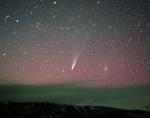 Ikeya Zhang: Comet Over Colorado
4.04.2002
Comet Ikeya-Zhang ("ee-KAY-uh JONG") has become a most photogenic comet. This lovely early evening view of the comet in Rocky Mountain skies looks northwest over ridges and low clouds. The time exposure was recorded on March 31st from an 8,000 foot elevation near Yampa, Colorado, USA.
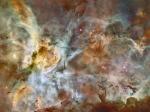 Carina Nebula Panorama from Hubble
25.04.2007
In one of the brightest parts of Milky Way lies a nebula where some of the oddest things occur. NGC 3372, known as the Great Nebula in Carina, is home to massive stars and changing nebula.
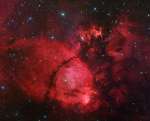 The Color of IC 1795
13.10.2011
This sharp cosmic portrait features glowing gas and obscuring dust clouds in IC 1795, a star forming region in the northern constellation Cassiopeia. Also cataloged as NGC 896, the nebula's remarkable details, shown...
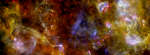 Herschel s Cygnus X
17.05.2012
The Herschel Space Observatory's infrared view of Cygnus X spans some 6x2 degrees across one of the closest, massive star forming regions in the plane of our Milky Way galaxy. In fact, the rich stellar nursery already holds the massive star cluster known as the Cygnus OB2 association.
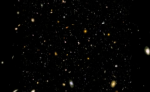 A Flight through the Hubble Ultra Deep Field
27.08.2013
What would it look like to fly through the distant universe? To find out, a team of astronomers estimated the relative distances to over 5,000 galaxies in one of the most distant fields of galaxies ever imaged: the Hubble Ultra Deep Field (HUDF).
|
January February March April May June July August September October |
|||||||||||||||||||||||||||||||||||||||||||||||||