
|
You entered: surface
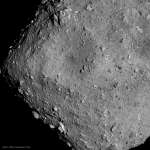 Asteroid Ryugu from Hayabusa2
21.08.2018
This big space diamond has an estimated value of over 80 billion dollars. It's only diamond in shape, though -- asteroid 162173 Ryugu is thought to be composed of mostly nickel and iron. Asteroids...
 Charon: Moon of Pluto
2.06.2023
A darkened and mysterious north polar region known to some as Mordor Macula caps this premier high-resolution view. The portrait of Charon, Pluto's largest moon, was captured by New Horizons near the spacecraft's closest approach on July 14, 2015.
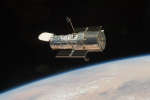 Hubble Floats Free
25.05.2009
Why put observatories in space? Most telescopes are on the ground. On the ground, you can deploy a heavier telescope and fix it more easily. The trouble is that Earth-bound telescopes must look through the Earth's atmosphere.
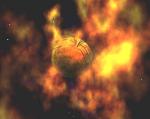 Magnetar
27.05.1998
What do you call a neutron star with a super-strong magnetic field? You guessed it ... a Magnetar. Imagine a star with more mass than the sun, the density of a neutron, and a magnetic field about a thousand trillion (a one followed by 15 zeroes) times stronger than Earth's.
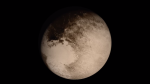 Flying Past Pluto
5.10.2015
What would it look like to fly past Pluto? The robotic New Horizons spacecraft did just this in late July and continues to return stunning pictures of the dwarf planet. Some well-chosen flyby images have now been digitally sequenced to create the featured video.
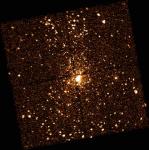 X-Ray Stars Of Orion
3.02.2000
The stars of Orion shine brightly in northern winter skies where the constellation harbors the closest large stellar nursery, the Great Nebula of Orion, a mere 1500 light-years away. In fact, the apparently bright...
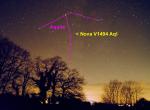 A Nova In Aquila
14.12.1999
On December 1st, experienced observers patroling the night sky with binoculars noticed what seemed to be a new star in the constellation of Aquila (The Eagle). It wasn't really a new star though.
 Jupiter in Infrared from Gemini
12.05.2020
In infrared, Jupiter lights up the night. Recently, astronomers at the Gemini North Observatory in Hawaii, USA, created some of the best infrared photos of Jupiter ever taken from EarthБs surface, pictured. Gemini...
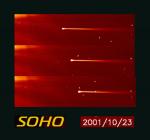 SOHO Comet 367: Sungrazer
8.11.2001
The most prolific comet discovering instrument in history rides aboard the sun-staring SOHO spacecraft, 1.5 million kilometers sunward of planet Earth. Of course, most of these SOHO comets have been sungrazers - like the one illustrated in the dramatic montage above.
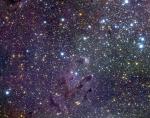 M16: Stars, Pillars and the Eagle s EGGs
2.01.2002
The Hubble Space Telescope's 1995 image of pillars of dust and gas, light-years long, within the Eagle Nebula (M16) was sensational. The three prominent pillars in that close-up visible light picture also appear...
|
January February March April May June July August September October |
|||||||||||||||||||||||||||||||||||||||||||||||||