
|
You entered: dust
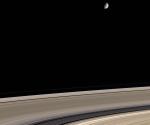 Saturn: Dirty Rings and a Clean Moon
6.06.2005
Eating surface ice from Enceladus might be healthier than eating ice from Saturn's rings -- it certainly appears cleaner. From their apparent densities and reflectance properties, both the rings of Saturn and its shiniest moon, Enceladus, are thought to be composed predominantly of water ice.
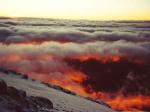 Sunrise Over Kilimanjaro
11.07.2005
Is the Roof of Africa on fire? A group hiking at 6 am near the top of Mt. Kilimanjaro watched the rising sun peak above the clouds and the horizon light up red. Don't worry -- in this case the highest volcano in Africa is not even erupting.
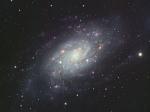 Spiral Galaxy NGC 2403 from Subaru
5.07.2006
Sprawling spiral arms dotted with bright red emission nebulas highlight this new and detailed image of nearby spiral galaxy NGC 2403. Also visible in the photogenic spiral galaxy are blue open clusters, dark dust lanes, and a bright but relatively small central nucleus.
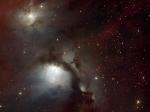 Reflection Nebulas in Orion
10.10.2006
In the vast Orion Molecular Cloud complex, several bright blue nebulas are particularly apparent. Pictured above are two of the most prominent reflection nebulas - dust clouds lit by the reflecting light of bright embedded stars. The more famous nebula is M78, near the image center, cataloged over 200 years ago.
 Comet Holmes Grows a Tail
4.11.2007
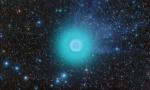
Comet Holmes continues to be an impressive sight to the unaided eye. The comet has diminished in brightness only slightly, and now clearly appears to have a larger angular extent than stars and planets. Astrophotographers have also noted a distinctly green appearance to the comet's coma over the past week.
 Messier 63: The Sunflower Galaxy
17.04.2008
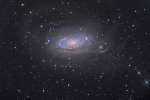
A bright spiral galaxy of the northern sky, Messier 63 is about 25 million light-years distant in the loyal constellation Canes Venatici. Also cataloged as NGC 5055, the majestic island universe is nearly 100,000 light-years across, about the size of our own Milky Way.
 Alnitak, Alnilam, Mintaka
20.01.2011
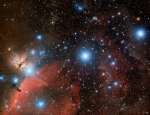
Alnitak, Alnilam, and Mintaka, are the bright bluish stars from east to west (left to right) along the diagonal in this gorgeous cosmic vista. Otherwise known as the Belt of Orion, these three blue supergiant stars are hotter and much more massive than the Sun.
 Clouds and Crosses over Haleakala
12.04.2014
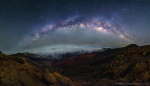
Aloha and welcome to a breathtaking skyscape. The dreamlike panoramic view from March 27 looks out over the 10,000 foot summit of Haleakala on Maui, Hawai'i. A cloud layer seeps over the volcanic caldera's edge with the Milky Way and starry night sky above.
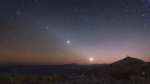 Planets of the Morning
25.11.2015
Planet Earth's horizon stretches across this recent Solar System group portrait, seen from the southern hemisphere's Las Campanas Observatory. Taken before dawn it traces the ecliptic with a line-up familiar to November's early morning risers.
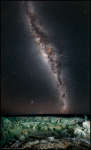 Southern Craters and Galaxies
25.12.2015
The Henbury craters in the Northern Territory, Australia, planet Earth, are the scars of an impact over 4,000 years old. When an ancient meteorite fragmented into dozens of pieces, the largest made the 180 meter diameter crater whose weathered walls and floor are lit in the foreground of this southern hemisphere nightscape.
|
January February March April May June July August September October |
|||||||||||||||||||||||||||||||||||||||||||||||||