
|
You entered: galaxies
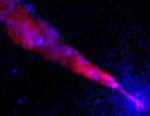 The Energetic Jet from Centaurus A
1.05.2003
The center of well-studied active galaxy Centaurus A is hidden from the view of optical telescopes by a cosmic jumble of stars, gas, and dust. But both radio and x-ray telescopes can trace the remarkable jet of high-energy particles streaming from the galaxy's core.
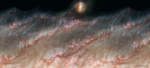 Unwinding M51
21.08.2020
The arms of a grand design spiral galaxy 60,000 light-years across are unwound in this digital transformation of the magnificent 2005 Hubble Space Telescope portrait of M51. In fact...
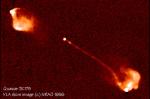 3C175: Quasar Cannon
5.09.2001
3C175 is not only a quasar, it is a galaxy-fueled particle cannon. Visible as the central dot is quasar 3C175, the active center of a galaxy so distant that the light we see from it was emitted when the Earth was just forming.
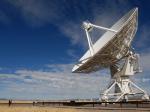 A Big Dish at the VLA Radio Observatory
29.11.2006
They are so large, they are almost unreal. The radio dishes of the Very Large Array (VLA) of radio telescopes might appear to some as a strange combination of a dinosaur skeleton and common satellite-TV receiving dish.
 Time Tunnel
6.09.2007
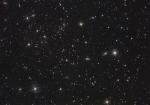
Spiky stars are nearby, but fuzzy galaxies are strewn far across the Universe in this cosmic view. Spanning about 1/2 degree on the sky, the pretty picture is the result of astronomer Johannes Schedler's project to look back in time, toward a quasar 12.7 billion light-years away.
 The Large Cloud of Magellan
16.10.2010
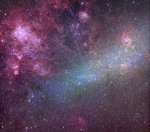
The 16th century Portuguese navigator Ferdinand Magellan and his crew had plenty of time to study the southern sky during the first circumnavigation of planet Earth. As a result, two fuzzy cloud-like objects easily...
 M51 Hubble Remix
26.12.2009
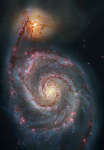
The 51st entry in Charles Messier's famous catalog is perhaps the original spiral nebula - a large galaxy with a well defined spiral structure also cataloged as NGC 5194. Over 60,000 light-years across, M51's spiral arms and dust lanes clearly sweep in front of its companion galaxy (right), NGC 5195.
 The Arms of M106
6.02.2013
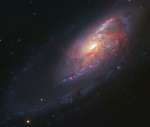
The spiral arms of bright galaxy M106 sprawl through this remarkable multiframe portrait, composed of data from ground- and space-based telescopes. Also known as NGC 4258, M106 can be found toward the northern constellation Canes Venatici. The well-measured distance to M106 is 23.5 million light-years, making this cosmic scene about 80,000 light-years across.
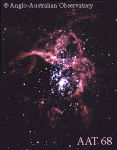 The Violent Star Cluster 30 Doradus
23.05.1996
The largest, most violent star forming region known in the whole Local Group of galaxies lies in our neighboring galaxy the LMC. Were 30 Doradus at the distance of the Orion Nebula -- a local star forming region -- it would take up fully half the sky.
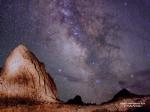 The Milky Way over Utah
1.08.2006
If sometimes it appears that the entire Milky Way Galaxy is raining down on your head, do not despair. It happens twice a day. As the Sun rises in the East, wonders of the night sky become less bright than the sunlight scattered by our own Earth's atmosphere, and so fade from view.
|
January February March April May June July August September October |
|||||||||||||||||||||||||||||||||||||||||||||||||