
|
You entered: planet
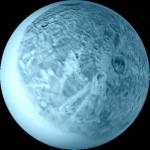 Hamlet of Oberon
31.01.1997
What's in a name? Since 1919, the International Astronomical Union has been charged with the task of establishing "conventional" nomenclature for planets, satellites, and surface features. For the remote Uranian system of moons, namesakes from Shakespearean works have been chosen.
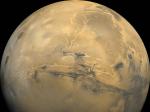 Valles Marineris: The Grand Canyon of Mars
30.07.2006
The largest canyon in the Solar System cuts a wide swath across the face of Mars. Named Valles Marineris, the grand valley extends over 3,000 kilometers long, spans as much as 600 kilometers across, and delves as much as 8 kilometers deep.
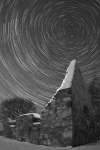 Star Trails in the North
24.12.2010
Pointing skyward, the wall of this ruined Viking church still stands after a thousand winters, near the town of Vallentuna, Sweden. The time exposure records the scene on December 14th as stars leave graceful arcing trails during a long night, reflecting planet Earth's daily rotation on its axis.
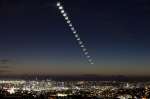 Morning, Moon, and Mercury
26.04.2012
Last week Mercury wandered far to the west of the Sun. As the solar system's innermost planet neared its greatest elongation or greatest angle from the Sun (for this apparition about 27 degrees) it was joined by an old crescent Moon.
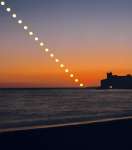 A Solstice Sunset Self Portrait
21.06.2013
Today, the solstice is at 05:04 Universal Time, the Sun reaching the northernmost declination in its yearly journey through planet Earth's sky. A June solstice marks the astronomical beginning of summer in the northern hemisphere and winter in the south.
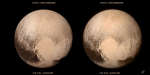 Stereo Pluto
6.08.2015
These two detailed, true color images of Pluto were captured during the historic New Horizons flyby last month. With slightly different perspectives on the now recognizeable surface features they are presented in this first high quality stereo pair intended for viewing by denizens of planet Earth.
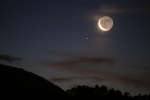 Saturn and the Da Vinci Glow
4.05.2019
On February 2nd early morning risers saw Saturn near an old Moon low on the eastern horizon. On that date bright planet, sunlit crescent, and faint lunar night side were captured in this predawn skyscape from Bursa, Turkey. Of course the Moon's ashen glow is earthshine, earthlight reflected from the Moon's night side.
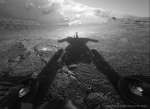 APOD: 2026 February 22 Б Shadow of a Martian Robot
22.02.2026
What if you saw your shadow on Mars and it wasn't human? Then you might be the Opportunity rover exploring Mars. Opportunity explored the Red Planet from 2004 to 2018, finding evidence of ancient water, and sending breathtaking images across the inner Solar System.
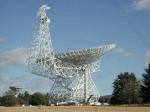 The 100 Meter Green Bank Radio Telescope
11.03.2002
The largest single-dish fully steerable radio telescope began operation in 2000 August in Green Bank, West Virginia, USA. Dedicated as the Robert C. Byrd Green Bank Telescope, the device weighs over 30 times more than the Statue of Liberty, and yet can point anywhere in the sky more precisely than one thousandth of a degree.
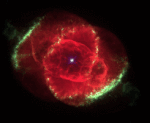 The Cat's Eye Nebula
28.06.1995
Three thousand light years away, a dying star throws off shells of glowing gas. This Hubble Space Telescope image reveals "The Cat's Eye Nebula" to be one of the most complex "planetary nebulae" known.
|
January February March April May June July August September October |
|||||||||||||||||||||||||||||||||||||||||||||||||