
|
You entered: sky
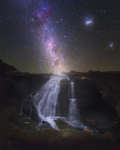 Milky Way Falls
12.01.2019
It can be the driest place on planet Earth, but water still flows in Chile's Atacama desert, high in the mountains. After discovering this small creek with running water, the photographer returned...
 M51: The Whirlpool Galaxy from Hubble
13.06.2022
The Whirlpool Galaxy is a classic spiral galaxy. At only 30 million light years distant and fully 60 thousand light years across, M51, also known as NGC 5194, is one of the brightest and most picturesque galaxies on the sky.
 Savudrija Star Trails
5.06.2025
Savudrija lighthouse shines along the coast near the northern end of the Istrian peninsula in this well-composed night skyscape. A navigational aid for sailors on the Adriatic Sea, the historic lighthouse was constructed in the early 19th century.
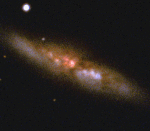 M82: An Irregular Galaxy
28.07.1995
Not all galaxies have spiral structure like our Milky Way. Many have smooth elliptical shapes, but also many have irregular shapes such as the bright sky object M82, the 82nd object on Messier's list.
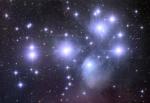 The Pleiades Star Cluster
27.12.2003
Perhaps the most famous star cluster on the sky, the Pleiades can be seen without binoculars from even the depths of a light-polluted city. Also known as the Seven Sisters and M45, the Pleiades is one of the brightest and closest open clusters.
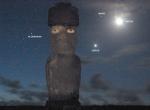 Planets Over Easter Island
24.05.2004
It isn't every day that planets line up behind a stone giant. For one thing, it helps to have a good planet line-up, such as occurred in the sky just last month. For another, it helps to be on Easter Island, where over 800 large stone statues exist.
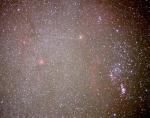 Meteor Milky Way
26.11.1998
The bold, bright star patterns of Orion (right) are a familiar sight to even casual skygazers. But this gorgeous color photo also features a subtler spectacle - the faint stars of the Milky Way.
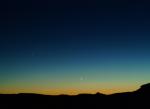 Planets in the West
24.06.2005
This weekend three planets will grace the western sky, forming a lovely trio easily visible shortly after sunset. Saturday evening in particular will find Saturn, Venus, and Mercury all within a 2 degree circle (about the size of your thumb held at arm's length) above the western horizon.
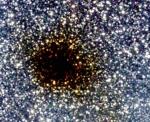 Dark Cloud
26.02.1999
Ominously foreshadowing events to come, a dark cloud of obscuring dust stands out against a luminous star field in the Milky Way. Cataloged as Feitzinger and Stuwe object "1-457" this fuliginous interstellar nebula is relatively close - possibly only 1,000 light-years distant.
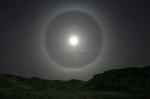 A Sun Halo over Utah
11.04.2006
Have you ever seen a halo around the Sun? This fairly common sight occurs when high thin clouds containing millions of tiny ice crystals cover much of the sky. Each ice crystal acts like a miniature lens.
|
January February March April May June July August September October |
|||||||||||||||||||||||||||||||||||||||||||||||||