
|
You entered: nearest stars
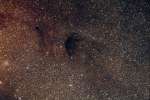 Dim World, Dark Nebula
8.07.2010
Dim, distant, dwarf planet Pluto can be hard to spot, especially in recent months as it wanders through the crowded starfields of Sagittarius and the central Milky Way. But fortunately for backyard Pluto hunters, it crossed in front of a dark nebula in early July.
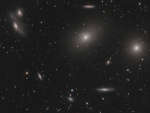 In the Heart of the Virgo Cluster
8.07.2008
The Virgo Cluster of Galaxies is the closest cluster of galaxies to our Milky Way Galaxy. The Virgo Cluster is so close that it spans more than 5 degrees on the sky - about 10 times the angle made by a full Moon.
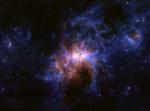 Dusty Environs of Eta Carinae
10.10.2002
Eta Car is a massive star, but it's not as bright as it used to be. Now only easily visible in binoculars or a small telescope, Eta Carinae has a history of spectacular flaring and fading behavior.
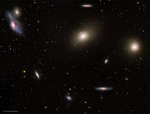 In the Heart of the Virgo Cluster
7.04.2015
The Virgo Cluster of Galaxies is the closest cluster of galaxies to our Milky Way Galaxy. The Virgo Cluster is so close that it spans more than 5 degrees on the sky - about 10 times the angle made by a full Moon.
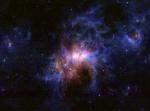 Dusty Environs of Eta Carinae
15.10.2005
Eta Car is a massive star, but it's not as bright as it used to be. Now only easily visible in binoculars or a small telescope, Eta Carinae has a history of spectacular flaring and fading behavior.
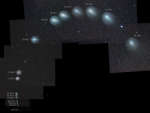 Three Month Composite of Comet Holmes
5.02.2008
How has Comet Holmes changed? Since brightening unexpectedly by nearly one million fold in late October, the last three months have found the coma of Comet 17P/Holmes both expanding and fading. This spectacular composite image shows how the coma and tail of Comet Holmes have changed.
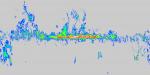 Milky Way Molecule Map
30.04.1997
Where are the Milky Way's gas clouds and where are they going? Stars form in gas clouds, and the motion of gas clouds tell us about the size and rotation speed of our own Milky Way Galaxy.
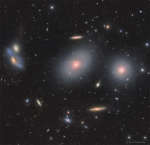 In the Heart of the Virgo Cluster
15.06.2022
The Virgo Cluster of Galaxies is the closest cluster of galaxies to our Milky Way Galaxy. The Virgo Cluster is so close that it spans more than 5 degrees on the sky - about 10 times the angle made by a full Moon.
 The Pencil Nebula Supernova Shock Wave
23.02.2024
This supernova shock wave plows through interstellar space at over 500,000 kilometers per hour. Centered and moving upward in the sharply detailed color composite its thin, bright, braided filaments are actually long ripples in a cosmic sheet of glowing gas seen almost edge-on.
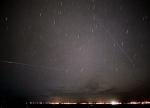 Mir Flares Farewell
23.03.2001
Streaking low across the western horizon after sunset, the Russian Mir space station makes a final pass through the evening sky above the coastal city of Salvador, Brazil. In this 5 minute 20 second time exposure made with ASA 800 film and a wide-angle lens on March 19, setting stars leave short, almost vertical trails.
|
January February March April May June July August September |
|||||||||||||||||||||||||||||||||||||||||||||||||