
|
You entered: color
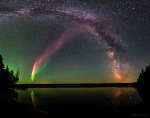 A Glowing STEVE and the Milky Way
17.11.2020
What's creating these long glowing streaks in the sky? No one is sure. Known as Strong Thermal Emission Velocity Enhancements (STEVEs), these luminous light-purple sky ribbons may resemble regular auroras, but recent research reveals significant differences.
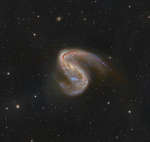 NGC 2442: Galaxy in Volans
29.01.2026
Distorted galaxy NGC 2442 can be found in the southern constellation of the flying fish, (Piscis) Volans. Located about 50 million light-years away, the galaxy's two spiral arms extending from a pronounced central...
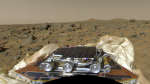 APOD: 2026 July 4 Б Pathfinder on Mars
4.07.2026
On July 4th, 1997, using its own array of fireworks, a parachute, and a cocoon of airbags, the Mars Pathfinder spacecraft bounced like a giant beach ball at least 15 times before it came to rest on the surface of Mars at 10:07 AM Pacific Daylight Time.
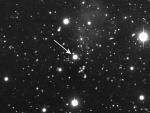 QSO H1821 643 Indicates a Universe Filled with Hydrogen
16.05.2000
A quasar slightly depleted of a specific color of light may indicate that our universe is filled with massive amounts of ionized hydrogen. Light from QSO H1821+643, pictured above, comes to us from about a quarter of the way across the visible universe.
 M57: The Ring Nebula
16.07.2000
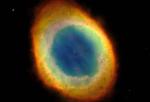
Except for the rings of Saturn, The Ring Nebula (M57) is probably the most famous celestial band. This planetary nebula's simple, graceful appearance is thought to be due to perspective -- our view from planet Earth looking straight into what is actually a barrel-shaped cloud of gas shrugged off by a dying central star.
 AE Aurigae: The Flaming Star
4.12.2001
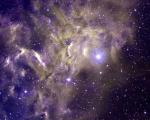
Is star AE Aurigae on fire? Although surrounded by what may look like smoke, the object known as the "flaming star" creates energy primarily by nuclear fusion, like other stars. Fire, typically defined...
 Finding Dark Matter
19.12.2001
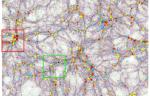
Where is dark matter? Galaxies rotate and move in clusters as if a tremendous amount of unseen matter is present. But does dark matter exist in the greater universe too -- and if so, where? The answer can be found by comparing the distribution of galaxies observed with numerical simulations.
 The Southern Sky in Warm Hydrogen
29.01.2002
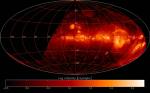
A robotic telescope with red sunglasses in Chile has been photographing the entire southern sky for years. The result, shown above, is the most complete sky map of the most common visible light emitted from the most abundant element in our Galaxy: hydrogen. A very specific red color emitted by warm ionized hydrogen was observed.
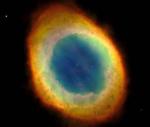 The Ring
7.01.1999
Except for the Rings of Saturn, The Ring Nebula (M57) is probably the most famous celestial band. This planetary nebula's simple, graceful appearance is thought to be due to perspective -- our view from planet Earth looking straight into what is actually a barrel-shaped cloud of gas shrugged off by a dying central star.
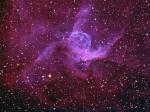 Thor s Helmet in H Alpha
2.02.2006
Near picture center, the helmet-shaped structure with wing-like appendages is popularly called Thor's Helmet. Cataloged as NGC 2359, the striking nebula is located about 15,000 light-years away in the constellation Canis Major.
|
January February March April May June July August September October |
|||||||||||||||||||||||||||||||||||||||||||||||||