
|
You entered: Milky Way
 From Auriga to Orion
22.03.2021
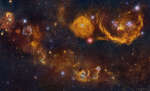
What's up in the sky from Auriga to Orion? Many of the famous stars and nebulas in this region were captured on 34 separate images, taking over 430 hours of exposure, and digitally combined to reveal the featured image.
 Shell Game in NGC 300
22.08.2002
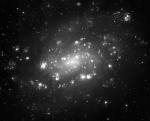
Featured in color in yesterday's episode, big, beautiful, face-on spiral galaxy NGC 300 is seen here through a narrow filter that transmits only the red light of hydrogen atoms. Ionized by energetic starlight, a hydrogen atom emits the characteristic red H-alpha light as its single electron is recaptured and transitions to lower energy states.
 The Heart in NGC 346
14.02.2003
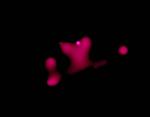
Yes, it's Valentine's Day (!) and looking toward star cluster NGC 346 in our neighboring galaxy the Small Magellanic Cloud, astronomers have noted this heart-shaped cloud of hot, x-ray emitting gas in the cluster's central region.
 Bright Star Knots in NGC 4038
2.06.1997
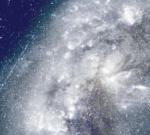
This galaxy is having a bad millennium. In fact, the past 100 million years haven't been so good, and probably the next billion or so should be quite tumultuous. NGC 4039 was a normal spiral galaxy, minding its own business, when NGC 4038 crashed into it.
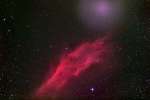 Comet over California
7.03.2008
Still gracing northern skies, a fading Comet Holmes lies at the top edge of this colorful skyview, recorded on March 4. The reddish emission nebula below it is NGC 1499, also known as the California Nebula for its resemblance to the outline of the state on the US west coast.
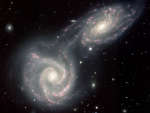 The Colliding Spiral Galaxies of Arp 271
21.07.2008
What will become of these galaxies? Spiral galaxies NGC 5426 and NGC 5427 are passing dangerously close to each other, but each is likely to survive this collision. Most frequently when galaxies collide, a large galaxy eats a much smaller galaxy.
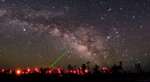 Messier Marathon
27.05.2011
In this action scene, red night vision lights, green laser pointers, tripods and telescopes in faint silhouette surround intrepid sky gazers embarked on the 10th annual Iran Messier Marathon. Completing the marathon requires viewing all 110 objects in 18th century French astronomer Charles Messier's catalog in one glorious dusk-to-dawn observing run.
 The Light of Stars
8.05.2012
What's moving? Time lapse videos of the sky can be quite spectacular when they last long enough for stars, planets, aurora, and clouds to appear to move in just a few seconds. Pictured...
 Journey to the Center of the Galaxy
2.07.2012
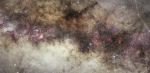
What wonders lie at the center of our Galaxy? In Jules Verne's science fiction classic A Journey to the Center of the Earth, Professor Liedenbrock and his fellow explorers encounter many strange and exciting wonders.
 Jones Emberson 1
12.07.2024
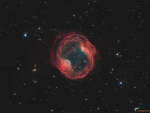
Planetary nebula Jones-Emberson 1 is the death shroud of a dying Sun-like star. It lies some 1,600 light-years from Earth toward the sharp-eyed constellation Lynx. About 4 light-years across, the expanding remnant...
|
January February March April May June July August September October |
|||||||||||||||||||||||||||||||||||||||||||||||||