
|
You entered: time
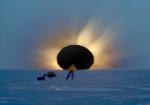 Solar Eclipse in View
7.04.2005
Friday's solar eclipse will be a rare hybrid - briefly appearing as either an annular eclipse or a total eclipse when viewed from along the narrow track of the Moon's shadow. Unfortunately that...
 Methane Dwarf
3.06.1999
While hunting through Sloan Sky Survey data in search of distant quasars, Princeton astronomers Xiaohui Fan and Michael Strauss came upon an undiscovered type of object very nearby - now dubbed a methane dwarf. Marked...
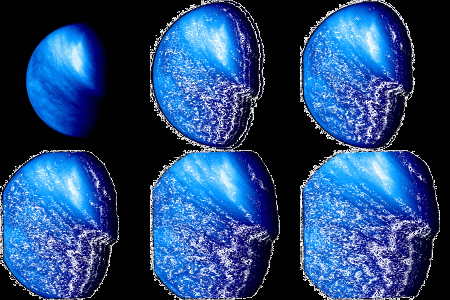 Venus Express Arrives at Venus
17.07.2006
Humanity now has a spacecraft orbiting Venus. The robotic Venus Express spacecraft launched by the European Space Agency in 2005 November arrived at Venus in 2006 April. Venus Express is now orbiting Earth's sister planet and returning pictures.
 Comet Encke s Tail Ripped off
3.10.2007
Swinging inside the orbit of Mercury, on April 20th periodic comet Encke encountered a blast from the Sun in the form of a Coronal Mass Ejection (CME). When CMEs, enormous clouds of energetic particles ejected from the Sun, slam into Earth's magnetosphere, they often trigger auroral displays.
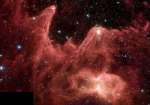 Mountains of Creation
15.12.2007
(xxxedit and linkxxx) This fantastic skyscape lies at the eastern edge of giant stellar nursery W5, about 7,000 light-years away in the constellation Cassiopeia. An infrared view from the Spitzer Space Telescope...
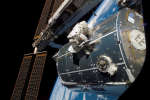 Columbus Laboratory Installed on Space Station
19.02.2008
The International Space Station (ISS) has been equipped with a powerful new scientific laboratory. The Space Shuttle Atlantis delivered the Columbus Laboratory to the ISS and installed the seven meter long module over the past week.
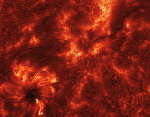 Spicules: Jets on the Sun
2.11.2010
Imagine a pipe as wide as a state and as long as the Earth. Now imagine that this pipe is filled with hot gas moving 50,000 kilometers per hour. Further imagine that this pipe is not made of metal but a transparent magnetic field.
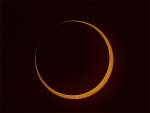 Cape York Annular Eclipse
11.05.2013
This week the shadow of the New Moon fell on planet Earth, crossing Queensland's Cape York in northern Australia ... for the second time in six months. On the morning...
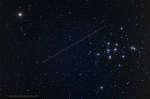 Close Encounter with M44
28.01.2015
On Monday, January 26, well-tracked asteroid 2004 BL86 made its closest approach, a mere 1.2 million kilometers from our fair planet. That's about 3.1 times the Earth-Moon distance or 4 light-seconds away. Moving...
 A Blue Hour Full Moon
26.08.2021
Nature photographers and other fans of planet Earth always look forward to the blue hour. That's the transition in twilight, just before sunrise or after sunset, when the Sun is below the horizon but land and sky are still suffused with a beautiful blue light.
|
January February March April May June July August |
||||||||||||||||||||||||||||||||||||||||||||||||||||||||