
|
You entered: stars
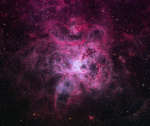 The Tarantula Nebula
16.11.2018
The Tarantula Nebula, also known as 30 Doradus, is more than a thousand light-years in diameter, a giant star forming region within nearby satellite galaxy the Large Magellanic Cloud. About 180 thousand light-years away, it's the largest, most violent star forming region known in the whole Local Group of galaxies.
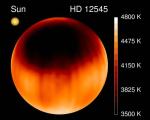 A Giant Starspot on HD 12545
12.07.2000
What could cause a star to have such a large spot? Our Sun itself frequently has sunspots, relatively cool dark magnetic depressions that move across its surface. HD 12545, however, exhibits the largest starspots yet observed.
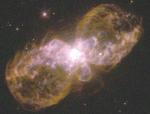 The Hubble 5 Planetary Nebula
18.01.1998
The Hubble Double Bubble Planetary Nebula is bubbling over with excitement. More mundanely known as Hubble 5, this bipolar planetary nebula is being created by a hot wind of particles streaming away from the central star system.
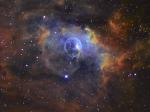 NGC 7635: The Bubble Nebula
6.11.2005
It's the bubble versus the cloud. NGC 7635, the Bubble Nebula, is being pushed out by the stellar wind of massive central star BD+602522. Next door, though, lives a giant molecular cloud, visible above to the lower right.
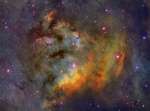 Sharpless 171
18.10.2008
Cosmic pillars of cold molecular gas and clouds of dark dust lie within Sharpless 171, a star-forming region some 3,000 light-years away in the royal constellation Cepheus. This tantalizing false-color skyscape spans about 20 light-years across the nebula's bright central region.
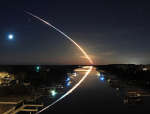 Waterway to Orbit
12.02.2010
The 32nd shuttle mission to the International Space Station, STS-130, left planet Earth on February 8. Its early morning launch to orbit from Kennedy Space Center's pad 39A followed the long, graceful, eastward arc seen in this 2 minute time exposure.
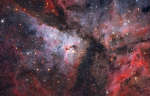 The Great Carina Nebula
26.12.2018
A jewel of the southern sky, the Great Carina Nebula, also known as NGC 3372, spans over 300 light-years, one of our galaxy's largest star forming regions. Like the smaller, more northerly Great...
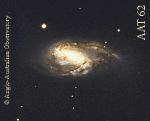 Unusual Spiral Galaxy M66
10.08.1996
Spiral galaxy M66 is largest galaxy in the a group known as the Leo Triplet. M66 is somewhat peculiar because of its asymmetric spiral arms. Usually dense waves of gas, dust, and newly formed stars - called spiral density waves - circle a galactic center and create a symmetric galaxy.
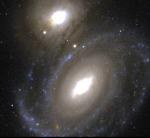 Galaxies Away
25.03.1998
This striking pair of galaxies is far, far away ... about 350 million light-years from Earth. Cataloged as AM0500-620, the pair is located in the southern constellation Dorado. The background elliptical and foreground spiral galaxy are representative of two of the three major classes of galaxies which inhabit our Universe.
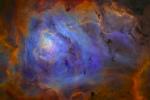 Blue Lagoon
25.08.2006
Stars come and go as you slide your cursor over this engaging image of M8, aka the Lagoon Nebula. Of course, the nebula is itself a star-forming region, but the stars that appear and disappear here include background and foreground stars that by chance lie along the same line of sight.
|
January February March April May June July August September October |
|||||||||||||||||||||||||||||||||||||||||||||||||