
|
You entered: planet
 APOD: 2023 August 23 Б The Meteor and the Galaxy
23.08.2023
It came from outer space. It -- in this case a sand-sized bit of a comet nucleus -- was likely ejected many years ago from Sun-orbiting Comet Swift-Tuttle, but then continued to orbit the Sun alone.
 APOD: 2026 June 27 Б Mars Marathon by Perseverance
27.06.2026
In this recent HiRISE view from the Mars Reconnaissance Orbiter, the little green dot indicated on the surface of the big Red Planet is the Perseverance Mars rover. Recorded on June 13, the car-sized...
 APOD: 2026 July 25 Б Tranquility and Serenity
25.07.2026
The Seas of Tranquility and Serenity are calm today. They're calm most every day though, since they are actually lunar maria, ancient lava flows filling in large impact basins on the Moon. Also...
 Olympus Mons on Mars: The Largest Volcano
15.09.1997
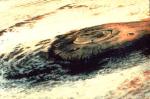
The largest volcano in the Solar System is on Mars. Olympus Mons rises 24 kilometers high and measures 550 km across. By comparison, Earth's largest volcano, Mauna Loa in Hawaii, rises 9 km high and measures 120 km across.
 The Largest Impact Crater
6.09.1996
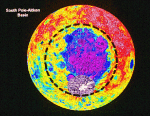
What is the largest known impact crater in the Solar System? Over 1300 miles across, the South Pole-Aitken Basin on the farside of Earth's Moon holds that distinction. Circled above in a false color mosaic of Clementine images it was caused when an asteroid or comet sized object crashed
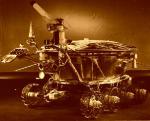 Lunokhod: Moon Robot
9.01.1999
On November 17, 1970 the Soviet Luna 17 spacecraft landed the first roving remote-controlled robot on the Moon. Known as Lunokhod 1, it weighed just under 2,000 pounds and was designed to operate...
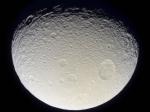 Saturns Moon Tethys from Cassini
29.11.2004
Tethys is one of the larger and closer moons of Saturn. The Cassini spacecraft now orbiting Saturn passed near the frozen moon at the end of October, capturing the most detailed images since the Voyager spacecrafts in the early 1980s.
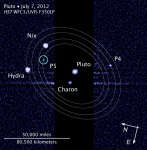 Fifth Moon Discovered Orbiting Pluto
16.07.2012
A fifth moon has been discovered orbiting Pluto. The moon was discovered earlier this month in images taken by the Hubble Space Telescope in preparation for the New Horizons mission's scheduled flyby of Pluto in 2015.
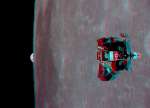 The Eagle Rises
21.07.2012
Get out your red/blue glasses and check out this remarkable stereo view from lunar orbit. Created from two photographs (AS11-44-6633, AS11-44-6634) taken by astronaut Michael Collins during the 1969 Apollo 11 mission...
 The Antikythera Mechanism
20.01.2013
What is it? It was found at the bottom of the sea aboard an ancient Greek ship. Its seeming complexity has prompted decades of study, although some of its functions remained unknown. X-ray images of the device have confirmed the nature of the Antikythera mechanism, and discovered several surprising functions.
|
January February March April May June July August September October |
|||||||||||||||||||||||||||||||||||||||||||||||||