
|
You entered: evening star
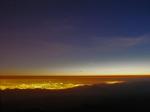 Three Planets from Mt Hamilton
30.06.2005
Venus, Mercury, and Saturn wandered close together in western evening skies last week. On Saturnday, June 25, astronomer R. Jay GaBany recorded this snapshot of their eye-catching planetary conjunction, from historic Lick Observatory on Mt. Hamilton, California, USA.
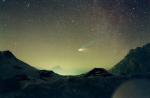 Comet Hale-Bopp Over Val Parola Pass
17.03.1997
Comet Hale-Bopp is now much brighter than any surrounding stars. It can be seen even over bright city lights. Out away from city lights, however, it is putting on quite a spectacular show. Here Comet Hale-Bopp was photographed last week above Val Parola Pass in the Dolomite mountains surrounding Cortina d'Ampezzo, Italy.
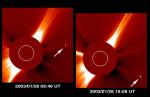 Comet Kudo-Fujikawa: Days in the Sun
30.01.2003
Cruising through the inner Solar System, new Comet Kudo-Fujikawa reached perihelion, its closest approach to the Sun, yesterday, January 29. Passing within 28.4 million kilometers of the Sun, this comet came much closer than innermost planet Mercury basking only 57.9 million kilometers from our parent star.
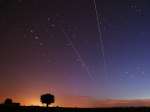 Chasing the ISS
4.06.2008
Bathed in sunlight, the International Space Station (ISS) arced through the evening sky above the town of Lauffen in southern Germany on May 31st. The timing of the bright passage was about 10 minutes after the launch of the Space Shuttle Discovery on the STS-124 mission from Kennedy Space Center, Florida, in the southeastern US.
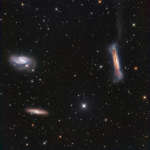 The Leo Trio
20.03.2021
This popular group leaps into the early evening sky around the March equinox and the northern hemisphere spring. Famous as the Leo Triplet, the three magnificent galaxies found in the prominent constellation Leo gather here in one astronomical field of view.
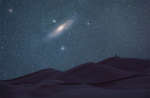 Andromeda over the Sahara Desert
11.07.2022
What is the oldest thing you can see? At 2.5 million light years distant, the answer for the unaided eye is the Andromeda galaxy, because its photons are 2.5 million years old when they reach you.
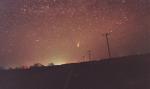 Comet Hale-Bopp is That Bright
27.02.1997
What's that fuzzy star? It's not a star, it's Comet Hale-Bopp. Not only has Comet Hale-Bopp become easy to see in the morning sky, it has become hard not to see it. It's that bright. Any morning just before sunrise, look towards the east.
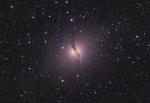 Jumbled Galaxy Centaurus A
30.06.2007
At the center of this sharp skyscape, Centaurus A seems to be a fantastic jumble of old yellow stars, young blue star clusters, and imposing dark dust lanes. Spanning over 60,000 light-years, the peculiar elliptical galaxy is apparently the result of a collision of two otherwise normal galaxies.
|
January February March April May June July August September October |
|||||||||||||||||||||||||||||||||||||||||||||||||