
|
You entered: nebula
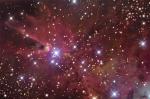 The Mysterious Cone Nebula
25.12.2005
Sometimes the simplest shapes are the hardest to explain. For example, the origin of the mysterious cone-shaped region seen on the far left remains a mystery. The interstellar formation, dubbed the Cone Nebula, is located about 2700 light years away.
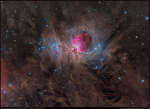 The Great Orion Nebula M42
4.11.2015
The Great Nebula in Orion, also known as M42, is one of the most famous nebulas in the sky. The star forming region's glowing gas clouds and hot young stars are on the right in this sharp and colorful image that includes the bluish reflection nebulae NGC 1977 and friends on the left.
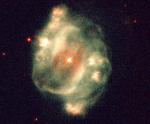 NGC 5307: A Symmetric Planetary Nebula
31.12.1997
Some stellar nebulae are strangely symmetric. For example, every major blob of gas visible on the upper left of NGC 5307 appears to have a counterpart on the lower right. This picture taken by the Hubble Space Telescope was released last week. NGC 5307 is an example of a planetary nebula with a spiral shape.
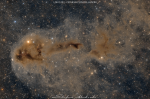 Lynds Dark Nebula 1251
24.11.2022
Stars are forming in Lynds Dark Nebula (LDN) 1251. About 1,000 light-years away and drifting above the plane of our Milky Way galaxy, the dusty molecular cloud is part of a complex of dark nebulae mapped toward the Cepheus flare region.
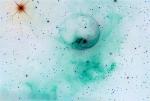 The Bubble Nebula from NOAO
17.06.2003
It's the bubble versus the cloud. NGC 7635, the Bubble Nebula, is being pushed out by the stellar wind of massive central star BD+602522. Next door, though, lives a giant molecular cloud, visible above to the lower right.
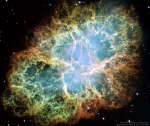 M1: The Crab Nebula from Hubble
9.09.2018
This is the mess that is left when a star explodes. The Crab Nebula, the result of a supernova seen in 1054 AD, is filled with mysterious filaments. The filaments are not only tremendously...
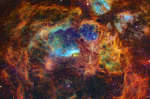 NGC 6357: The Lobster Nebula
28.10.2020
Why is the Lobster Nebula forming some of the most massive stars known? No one is yet sure. Cataloged as NGC 6357, the Lobster Nebula houses the open star cluster Pismis 24 near its center -- a home to unusually bright and massive stars.
 APOD: 2025 October 21 Б IC 1805: The Heart Nebula
21.10.2025
What electrifies the Heart Nebula? First, the large emission nebula on the left, catalogued as IC 1805, looks somewhat like a human heart. The nebula glows brightly in red light emitted by its most prominent element, hydrogen, but this long-exposure image was also blended with light emitted by sulfur (yellow) and oxygen (blue).
 The Heart and Soul Nebulas
11.02.2014
Is the heart and soul of our Galaxy located in Cassiopeia? Possibly not, but that is where two bright emission nebulas nicknamed Heart and Soul can be found. The Heart Nebula, officially dubbed IC 1805 and visible in the above zoomable view on the right, has a shape reminiscent of a classical heart symbol.
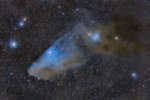 IC 4592: The Blue Horsehead Reflection Nebula
2.04.2013
Do you see the horse's head? What you are seeing is not the famous Horsehead nebula toward Orion but rather a fainter nebula that only takes on a familiar form with deeper imaging. The main part of the above imaged molecular cloud complex is a reflection nebula cataloged as IC 4592.
|
January February March April May June July August |
||||||||||||||||||||||||||||||||||||||||||||||||||||||||