
|
You entered: radio
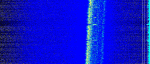 An Anomalous SETI Signal
30.03.1999
No one knows for sure what caused this signal. The bright colors on the blue background indicate that an anomalous signal was received here on Earth by a radio telescope involved in a Search for Extraterrestrial Intelligence (SETI). A search for these signals is ongoing by several groups including volunteer members of the SETI League.
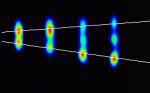 Micro-Quasar GRS1915 Puffs
1.12.1997
On the far side of our Galaxy, gas clouds explode away from a small black hole. This might seem peculiar, as black holes are supposed to attract matter. But material falling toward a black hole collides and heats up, creating an environment similar to a quasar that is far from stable.
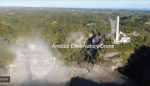 Arecibo Telescope Collapse
8.12.2020
This was one great scientific instrument. Starting in 1963, the 305-meters across Arecibo Telescope in Puerto Rico USA reigned as the largest single-dish radio telescope in the world for over 50 years. Among numerous...
 APOD: 2025 August 30 Б A Two Percent Moon
29.08.2025
A young crescent moon can be hard to see. That's because when the Moon shows it's crescent phase (young or old) it can never be far from the Sun in planet Earth's sky.
 A RADARSAT Map of Antarctica
15.11.1999
It's not easy to make a map of Antarctica. Earth's southern most continent is so cold and inhospitable that much of it remains unexplored. From space, though, it is possible to map this entire region by radar: by systematically noting how long it takes for radio waves to reflect off the terrain.
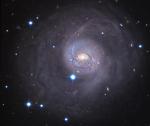 The Outskirts of M77
6.12.2006
Face-on spiral galaxy M77 lies a mere 60 million light-years away toward the constellation Cetus. Also known as NGC 1068, it's very bright core is well studied by astronomers exploring the mysteries of supermassive black holes in active galaxies.
 The Magellanic Stream
26.08.1998
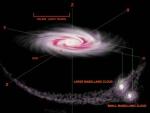
Spanning the sky behind the majestic Clouds of Magellan is an unusual stream of gas: the Magellanic Stream. The origin of this gas might hold a clue to origin and fate of our Milky Way's most famous satellite galaxies: the LMC and the SMC.
 Haunting Mars
30.10.1997
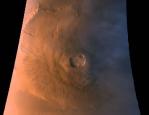
This Halloween, the news about Mars is good news - Mars Global Surveyor will resume aerobraking into a mapping orbit around the haunting red planet. Wide angle cameras onboard the spacecraft recently recorded this shadowy image of Olympus Mons, the Solar System's largest volcano, from an altitude of over 100 miles.
 Hale-Bopp and the Plateau de Bure Interferometer
15.04.1997
Comet Hale-Bopp is being observed by many different telescopes. Here the comet is pictured behind the array of radio telescopes which compose the Plateau de Bure Interferometer. These telescopes are being used to detect the presence of different molecules in the coma and tail of Comet Hale-Bopp.
 A Bulls Eye Einstein Ring
30.03.1998
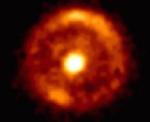
Can one galaxy hide behind another? Not in the case of B1938+666. Here the foreground galaxy acts like a huge gravitational lens, pulling the light from the background object around it, keeping it visible.
|
January February March April May June July August September October |
|||||||||||||||||||||||||||||||||||||||||||||||||