
|
You entered: ring galaxy
 The Deep Lagoon
27.09.2023
Ridges of glowing interstellar gas and dark dust clouds inhabit the turbulent, cosmic depths of the Lagoon Nebula. Also known as M8, The bright star forming region is about 5,000 light-years distant. It makes for a popular stop on telescopic tours of the constellation Sagittarius toward the center of our Milky Way Galaxy.
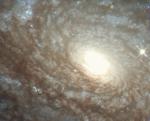 NGC 4414: A Flocculent Spiral Galaxy
3.04.2002
How much mass do flocculent spirals hide? The above true color image of flocculent spiral galaxy NGC 4414 was taken with the Hubble Space Telescope to help answer this question. Flocculent spirals -- galaxies without well defined spiral arms -- are a quite common form of galaxy, and NGC 4414 is one of the closest.
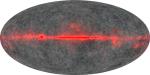 Universe Age from the Microwave Background
16.02.2003
The above sky map tells us the universe is 13.7 billion years old -- but how? At first look, one only sees the microwave glow of gas from our Milky Way Galaxy, coded red, and a spotty pattern of microwaves emitted from the early universe, coded in gray.
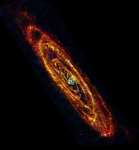 Herschel s Andromeda
2.02.2013
This infrared view from the Herschel Space Observatory explores the Andromeda Galaxy, the closest large spiral galaxy to our own Milky Way. Only 2.5 million light-years distant, the famous island universe is also known to astronomers as M31. Andromeda spans over 200,000 light-years making it more the twice the size of the Milky Way.
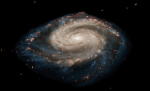 Virtual Flyby of the Whirlpool Galaxy
5.05.2019
What would it look like to fly over a spiral galaxy? To help visualize this, astronomers and animators at the Space Telescope Science Institute computed a virtual flyby of the Whirlpool Galaxy (M51) using data and images from the Hubble Space Telescope.
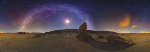 The Milky Way Over Tenerife
5.04.2011
Have you ever seen the band of our Milky Way Galaxy? Chances are you have never seen it like this -- nor could you. In a clear sky from a dark location at the right time, a faint band of light is visible across the sky. This band is the disk of our spiral galaxy.
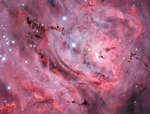 The Deep Lagoon
28.07.2015
Ridges of glowing interstellar gas and dark dust clouds inhabit the turbulent, cosmic depths of the Lagoon Nebula. Also known as M8, The bright star forming region is about 5,000 light-years distant.
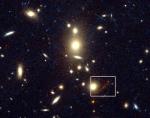 Behind CL1358+62: A New Farthest Object
31.07.1997
What if we could see back to the beginning of the universe? At one tenth the universe's present age, we might see galaxies forming. But what did galaxies look like when they were forming?
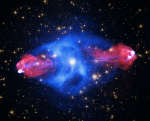 Light from Cygnus A
23.01.2015
Celebrating astronomy in this International Year of Light, the detailed image reveals spectacular active galaxy Cygnus A in light across the electromagnetic spectrum. Incorporating X-ray data ( blue) from the orbiting Chandra Observatory, Cygnus A is seen to be a prodigious source of high energy x-rays.
 Billows of Smog in the Outer Galaxy
14.01.2001
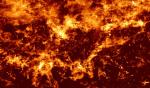
Our Galaxy is filled with gas. Most of this gas is hydrogen, some is helium, but there is a trace amount of relatively heavy molecules, including carbon monoxide (CO) - a component of smog. The above wide-angle radio CO image shows the incredibly diverse structures that the molecular interstellar medium forms.
|
January February March April May June July August September October |
|||||||||||||||||||||||||||||||||||||||||||||||||