
|
You entered: satellite
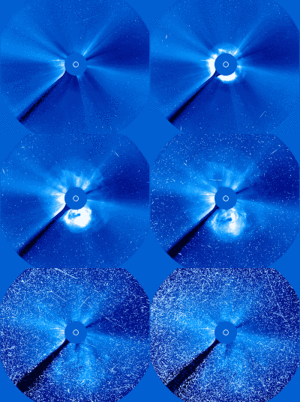 A Powerful Solar Flare
2.09.2018
It was one of the most powerful solar flares in recorded history. Occurring in 2003 and seen across the electromagnetic spectrum, the Sun briefly became over 100 times brighter in X-rays than normal.
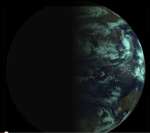 Earth at Equinox
22.09.2014
Earth is at equinox. Over the next 24 hours, day and night have nearly equal duration all over planet Earth. Technically, equinox transpires at 2:29 am Universal Time tomorrow, but this occurs today in North and South America.
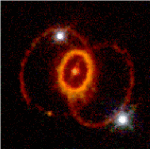 Supernova 1987a Aftermath
21.06.1995
In 1987 a star in one of the Milky Way's satellite galaxies exploded. In 1994 the Hubble Space Telescope, in orbit around the earth, took a very detailed picture of the remnants of this explosion. This picture, above, showed unusual and unexpected rings, and astronomers are not sure how they formed.
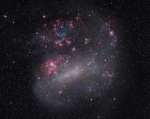 Hydrogen in the LMC
26.04.2011
A satellite galaxy of our own Milky Way, the Large Magellanic Cloud (LMC) is an alluring sight in dark southern skies and the constellation Dorado. A mere 180,000 light-years distant...
 Planck Maps the Microwave Background
25.03.2013
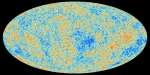
What is our universe made of? To help find out, ESA launched the Planck satellite to map, in unprecedented detail, slight temperature differences on the oldest surface known -- the background sky left billions of years ago when our universe first became transparent to light.
 Gamma-Ray Burster
19.03.1997
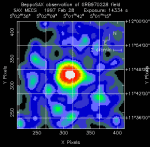
What and where are the Gamma-Ray Bursters? Since their discovery in the early 1970s, nobody has been able to explain the cause of mysterious flashes of gamma rays that come from seemingly random directions on the sky.
 SIRTF Streak
5.09.2003
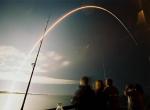
Streaking skyward, a Boeing Delta 2-Heavy rocket carries NASA's Space InfraRed Telescope Facility (SIRTF) aloft during the early morning hours of August 25th. The dramatic scene was recorded in a time exposure from...
 Namibian Nights
4.02.2013
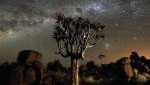
Namibia has some of the darkest nights visible from any continent. It is therefore home to some of the more spectacular skyscapes, a few of which have been captured in the above time-lapse video.
 The Farthest Explosion Yet Measured
19.10.2000
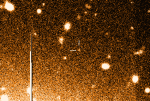
It happened so far away that common human distance measures are inadequate to describe it. Furthermore, astronomers do not even claim to know exactly what happened. What is known is that satellites across our Solar System reported on 2000 January 31 a tremendous explosion of gamma rays had occurred towards some previously uninteresting direction.
 Galaxy Einstein Ring
20.04.2016
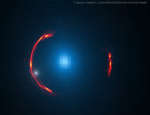
Can one galaxy hide behind another? Not in the case of SDP.81. Here the foreground galaxy, shown in blue in an image taken by the Hubble Space Telescope, acts like a huge gravitational...
|
January February March April May June July August |
||||||||||||||||||||||||||||||||||||||||||||||||||||||||