
|
You entered: spacecraft
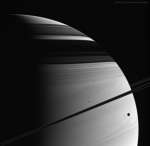 Moons, Rings, Shadows, Clouds: Saturn (Cassini)
2.04.2018
While cruising around Saturn, be on the lookout for picturesque juxtapositions of moons, rings, and shadows. One quite picturesque arrangement occurred in 2005 and was captured by the then Saturn-orbiting Cassini spacecraft. In the featured image, moons Tethys and Mimas are visible on either side of Saturn's thin rings, which are seen nearly edge-on.
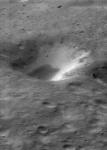 A Two Toned Crater on Asteroid Eros
22.01.2001
What lies beneath the surface of asteroid Eros? This image taken two weeks ago by the robot NEAR spacecraft orbiting the dark asteroid shows a kilometer-wide crater where some type of light material lies beneath some of the darker surface regolith.
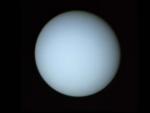 Uranus: The Tilted Planet
26.08.2001
Uranus is the third largest planet in our Solar System after Jupiter and Saturn. Uranus is composed mostly of rock and ices, but with a thick hydrogen and helium atmosphere. The blue hue of Uranus' atmosphere arises from the small amount of methane which preferentially absorbs red light.
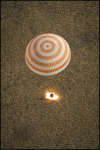 A Landing on Planet Earth
14.09.2013
With parachute deployed and retro-rockets blazing, this spacecraft landed on planet Earth on September 11 (UT) in a remote area near the town of Zhezkazgan, Kazakhstan. Seen in silhouette against the rockets' glare, the spacecraft is a Soyuz TMA-08M.
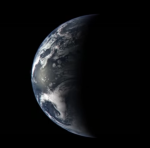 Leaving Earth
9.08.2022
What it would look like to leave planet Earth? Such an event was recorded visually in great detail by the MESSENGER spacecraft as it swung back past the Earth in 2005 on its way in toward the planet Mercury. Earth can be seen rotating in this time-lapse video, as it recedes into the distance.
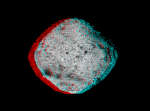 3D Bennu
11.03.2023
Put on your red/blue glasses and float next to asteroid 101955 Bennu. Shaped like a spinning toy top with boulders littering its rough surface, the tiny Solar System world is about one Empire State Building (less than 500 meters) across.
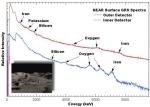 Survivor: NEAR Shoemaker On Asteroid Eros
5.03.2001
Not part of a television game series, the NEAR Shoemaker spacecraft survived its unprecedented landing on an on asteroid last month. As suggested in the illustration inset above, the car-sized probe likely rests gently on the tips of its solar panels having touched down under the influence of asteroid Eros' feeble gravity.
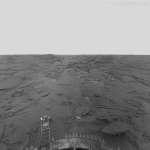 The Surface of Venus from Venera 13
17.03.2021
If you could stand on Venus -- what would you see? Pictured is the view from Venera 13, a robotic Soviet lander which parachuted and air-braked down through the thick Venusian atmosphere in March of 1982.
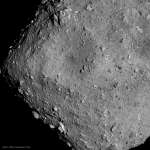 Asteroid Ryugu from Hayabusa2
22.08.2018
This big space diamond has an estimated value of over 80 billion dollars. It's only diamond in shape, though -- asteroid 162173 Ryugu is thought to be composed of mostly nickel and iron. Asteroids...
 Galileo s Europa
29.03.2024
Looping through the Jovian system in the late 1990s, the Galileo spacecraft recorded stunning views of Europa and uncovered evidence that the moon's icy surface likely hides a deep, global ocean. Galileo...
|
January February March April May June July August September October |
|||||||||||||||||||||||||||||||||||||||||||||||||