
|
You entered: volcano
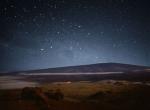 Southern Cross in Mauna Loa Skies
25.04.2002
Gazing across this gorgeous skyscape, the Southern Cross and stars of the constellation Centaurus are seen above the outline of Mauna Loa (Long Mountain), planet Earth's largest volcano. Unfamiliar to sky gazers north...
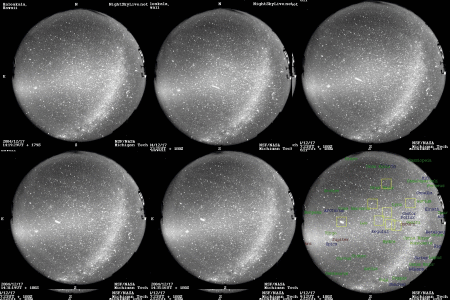 A Mysterious Streak Above Hawaii
8.02.2005
What in heavens-above was that? Not everything seen on the night sky is understood. The Night Sky Live (NSL) project keeps its global array of continuously updating web cameras (CONCAMs) always watching the night sky.
 The Milky Way Over Tenerife
5.04.2011
Have you ever seen the band of our Milky Way Galaxy? Chances are you have never seen it like this -- nor could you. In a clear sky from a dark location at the right time, a faint band of light is visible across the sky. This band is the disk of our spiral galaxy.
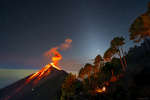 A Volcanic Great Conjunction
20.12.2020
Where can I see the Great Conjunction? Near where the Sun just set. Directionally, this close passing of Jupiter and Saturn will be toward the southwest. Since the planetary pair...
 Balloon TIGER
1.02.2002
Where does a two-ton tiger hang out? Well, in this case the Trans-Iron Galactic Element Recorder (TIGER) experiment hangs from a mobile crane on the far left in this panorama photo recorded last December near McMurdo Station, Antarctica.
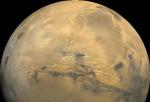 Mars: Just The Facts
27.06.1997
Mars, the freeze-dried planet, orbits 137 million miles from the Sun or at about 1.5 times the Earth-Sun distance. It has two diminutive moons, towering extinct volcanos, an immense canyon system, a thin atmosphere...
 APOD: 2023 October 23 Б Moon Io from Spacecraft Juno
23.10.2023
There goes another one! Volcanoes on Jupiter's moon Io keep erupting. To investigate, NASA's robotic Juno spacecraft has begun a series of visits to this very strange moon. Io is about...
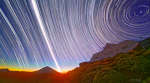 APOD: 2026 March 20 Б Spring Equinox at Teide Observatory
20.03.2026
The defining astronomical moment of the equinox today is at 14:46 UTC (March 20). That's when the Sun crosses the celestial equator moving north in its yearly journey through planet Earth's sky, marking the beginning of spring for our fair planet in the northern hemisphere and fall in the southern hemisphere.
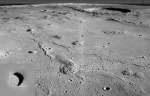 Marius Hills: Holes in the Moon
25.10.2017
Could humans live beneath the surface of the Moon? This intriguing possibility was bolstered in 2009 when Japan's Moon-orbiting SELENE spacecraft imaged a curious hole beneath the Marius Hills region on the Moon, possibly a skylight to an underground lava tube.
 Highest, Tallest, and Closest to the Stars
25.02.2016
Fans of planet Earth probably recognize its highest mountain, the Himalayan Mount Everest, on the left in this 3-panel skyscape of The World at Night. Shrouded in cloud Everest's peak is at 8,848 meters (29,029 feet) elevation above sea level.
|
January February March April May June July August September October |
|||||||||||||||||||||||||||||||||||||||||||||||||