
|
You entered: Milky Way
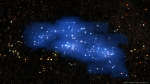 Hyperion: Largest Known Galaxy Proto Supercluster
23.10.2018
How did galaxies form in the early universe? To help find out, astronomers surveyed a patch of dark night sky with the Very Large Telescope array in Chile to find and count galaxies that formed when our universe was very young.
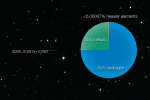 J102815: A Star That Should Not Exist
7.09.2011
Why does this star have so few heavy elements? Stars born in the generation of our Sun have an expected abundance of elements heavier than hydrogen and helium mixed into their atmospheres. Stars born...
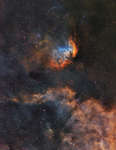 The Tulip and Cygnus X 1
29.07.2021
This tall telescopic field of view looks out along the plane of our Milky Way Galaxy toward the nebula rich constellation Cygnus the Swan. Popularly called the Tulip Nebula, the brightest glowing cloud of interstellar gas and dust above center is also found in the 1959 catalog by astronomer Stewart Sharpless as Sh2-101.
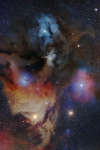 APOD: 2026 July 1 Б The Cotton Candy Clouds of Rho Ophiuchi
1.07.2026
Although they look like cotton candy, you cannot eat these clouds! Taken in Cádiz, Spain, today's image features the Rho Ophiuchi complex, a rich tapestry of young and old astronomical phenomena. This colorful cloud complex is a nearby star-forming region containing hundreds of young stellar objects, including protostars and T Tauri stars.
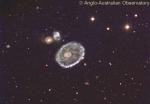 The Cartwheel Galaxy
12.06.2001
By chance, a collision of two galaxies has created a surprisingly recognizable shape on a cosmic scale. The Cartwheel Galaxy is part of a group of galaxies about 500 million light years away in the constellation Sculptor. Two smaller galaxies in the group are visible on the left of the above photograph.
 The Gamma Ray Moon
10.02.1997
What if you could see gamma rays (photons with more than 40 million times the energy of visible light)? If you could, the Moon would appear brighter than the Sun! This startling notion...
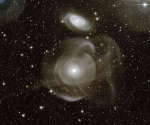 Galaxy NGC 474: Cosmic Blender
26.07.2011
What's happening to galaxy NGC 474? The multiple layers of emission appear strangely complex and unexpected given the relatively featureless appearance of the elliptical galaxy in less deep images. The cause...
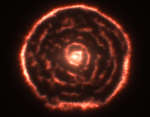 A Spiral Nebula Surrounding Star R Sculptoris
16.10.2012
What's happening around that star? An unusual spiral structure has been discovered around the Milky Way star R Sculptoris, a red giant star located about 1,500 light years away toward the constellation of the Sculptor (Sculptoris).
 V838 Light Echo: The Movie
17.06.2014
What caused this outburst of V838 Mon? For reasons unknown, star V838 Mon suddenly became one of the brightest stars in the entire Milky Way Galaxy. Then, just a few months later, it faded.
 Rainbow Airglow over the Azores
22.03.2016
Why would the sky glow like a giant repeating rainbow? Airglow. Now air glows all of the time, but it is usually hard to see. A disturbance however -- like an approaching storm -- may cause noticeable rippling in the Earth's atmosphere.
|
January February March April May June July August September October |
|||||||||||||||||||||||||||||||||||||||||||||||||