
|
You entered: nebula
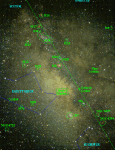 The Annotated Galactic Center
11.11.1997
The sky toward the center of our Galaxy is filled with a wide variety of celestial wonders. Most are visible with only binoculars. Constellations of nearby stars include Sagittarius, Libra, Scorpius, Scutum, and Ophiuchus. Nebulae include Messier Objects M8, M16, M17, M20 and the Pipe Nebula.
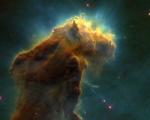 Eagle Eggs in M16
28.02.1998
Star forming regions known as "EGGs" are uncovered at the end of this giant pillar of gas and dust in the Eagle Nebula (M16). EGGs, short for evaporating gaseous globules, are dense regions of mostly molecular hydrogen gas that fragment and gravitationally collapse to form stars.
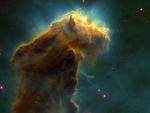 Eagle EGGs in M16
2.04.2000
Star forming regions known as "EGGs" are uncovered at the end of this giant pillar of gas and dust in the Eagle Nebula (M16). EGGs, short for evaporating gaseous globules, are dense regions of mostly molecular hydrogen gas that fragment and gravitationally collapse to form stars.
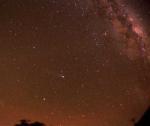 Comet Hyakutake and the Milky Way
17.08.1998
Two years ago, the Great Comet of 1996, Comet Hyakutake, inched across our northern sky during its long orbit around the Sun. Visible above as the bright spot with the faint tail near...
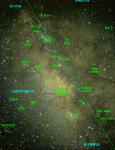 The Annotated Galactic Center
29.12.2001
The sky toward the center of our Galaxy is filled with a wide variety of celestial wonders. Many are easily visible with binoculars. Constellations near the galactic center include Sagittarius, Libra, Scorpius, Scutum, and Ophiuchus. Nebulae include Messier Objects M8, M16, M17, M20 and the Pipe Nebula.
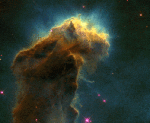 Eagle EGGs in M16
7.11.1995
Star forming regions known as "EGGs" are uncovered at the end of this giant pillar of gas and dust in the Eagle Nebula (M16). EGGs, short for evaporating gaseous globules, are dense regions of mostly molecular hydrogen gas that fragment and gravitationally collapse to form stars.
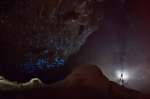 The Starry Sky under Hollow Hill
30.08.2014
Look up in New Zealand's Hollow Hill Cave and you might think you see a familiar starry sky. And that's exactly what Arachnocampa luminosa are counting on. Captured in this long exposure...
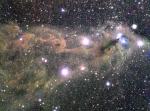 Star Clouds Toward the Southern Crown
2.10.2002
The flowing trails of dust toward Corona Australis, the constellation of the Southern Crown, are visible here because not because they glow, but because they absorb and reflect. The dust appears bluer when seen near bright stars because it preferentially reflects blue light.
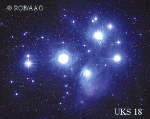 The Pleiades Star Cluster
3.09.1996
It is the most famous star cluster on the sky. The Pleiades can be seen without binoculars from even the depths of a light-polluted city. Also known as the Seven Sisters and M45, the Pleiades is one of the brightest and most easily visible open clusters on the sky.
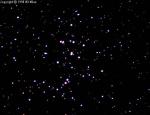 M44: A Beehive of Stars
3.08.1998
M44 is a prominent open cluster of stars. Nicknamed Praesepe and "The Beehive", it is one of the few open clusters visible to the unaided eye. M44 was thought to be a nebula until Galileo used an early telescope to resolve the cluster's bright blue stars. These stars are visible in the above image.
|
January February March April May June July August |
||||||||||||||||||||||||||||||||||||||||||||||||||||||||