
|
You entered: Milky Way
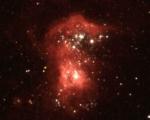 Bright Stars, Dim Galaxy
3.11.2001
These two clusters of bright, newly formed stars surrounded by a glowing nebula lie 10 million light-years away in the dim, irregular galaxy cataloged as NGC 2366. The Hubble Space Telescope image shows that...
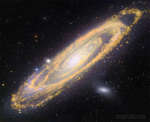 The Once and Future Stars of Andromeda
23.05.2022
This picture of Andromeda shows not only where stars are now, but where stars will soon be. Of course, the big, beautiful Andromeda Galaxy, M31, is a spiral galaxy -- and a mere 2.5 million light-years away.
 The Once and Future Stars of Andromeda
7.10.2023
This picture of Andromeda shows not only where stars are now, but where stars will be. The big, beautiful Andromeda Galaxy, M31, is a spiral galaxy a mere 2.5 million light-years away. Image data...
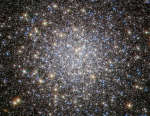 Hubble s Messier 5
4.11.2017
"Beautiful Nebula discovered between the Balance [Libra] & the Serpent [Serpens] ..." begins the description of the 5th entry in 18th century astronomer Charles Messier's famous catalog of nebulae and star clusters. Though it appeared...
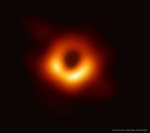 First Horizon Scale Image of a Black Hole
11.04.2019
What does a black hole look like? To find out, radio telescopes from around the Earth coordinated observations of black holes with the largest known event horizons on the sky. Alone, black holes are just black, but these monster attractors are known to be surrounded by glowing gas.
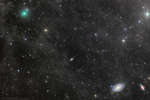 Comet ATLAS and the Mighty Galaxies
21.03.2020
Comet ATLAS C/2019 Y4 was discovered by the NASA funded Asteroid Terrestrial-impact Last Alert System, the last comet discovery reported in 2019. Now growing brighter in northern night skies, the comet's pretty greenish...
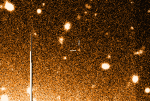 The Farthest Explosion Yet Measured
19.10.2000
It happened so far away that common human distance measures are inadequate to describe it. Furthermore, astronomers do not even claim to know exactly what happened. What is known is that satellites across our Solar System reported on 2000 January 31 a tremendous explosion of gamma rays had occurred towards some previously uninteresting direction.
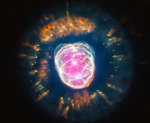 The Eskimo Nebula from Hubble and Chandra
30.07.2013
In 1787, astronomer William Herschel discovered the Eskimo Nebula. From the ground, NGC 2392 resembles a person's head surrounded by a parka hood. In 2000, the Hubble Space Telescope imaged the Eskimo Nebula in visible light, while the nebula was imaged in X-rays by the Chandra X-ray Observatory in 2007.
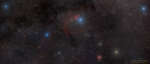 The W in Cassiopeia
18.03.2016
A familiar, zigzag, W pattern in northern constellation Cassiopeia is traced by five bright stars in this colorful and broad mosaic. Stretching about 15 degrees across rich starfields, the celestial scene includes dark clouds, bright nebulae, and star clusters along the Milky Way. In yellow-orange hues Cassiopeia's alpha star Shedar is a standout though.
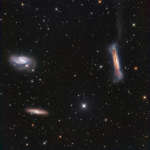 The Leo Trio
20.03.2021
This popular group leaps into the early evening sky around the March equinox and the northern hemisphere spring. Famous as the Leo Triplet, the three magnificent galaxies found in the prominent constellation Leo gather here in one astronomical field of view.
|
January February March April May June July August September October |
|||||||||||||||||||||||||||||||||||||||||||||||||