
|
You entered: cluster
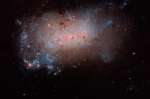 NGC 4449: Close up of a Small Galaxy
14.07.2017
(xxxedit and linkxxx) Grand spiral galaxies often seem to get all the glory. Their young, blue star clusters and pink star forming regions along sweeping spiral arms are guaranteed to attract attention. But small irregular galaxies form stars too, like NGC 4449, about 12 million light-years distant.
 When Z is for Mars
15.04.2023
A composite of images captured about a week apart from mid August 2022 through late March 2023, this series traces the retrograde motion of ruddy-colored Mars. Progressing from lower right to upper left Mars...
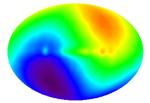 CMBR Dipole: Speeding Through the Universe
8.10.2006
Our Earth is not at rest. The Earth moves around the Sun. The Sun orbits the center of the Milky Way Galaxy. The Milky Way Galaxy orbits in the Local Group of Galaxies. The Local Group falls toward the Virgo Cluster of Galaxies.
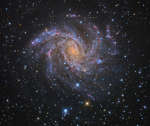 Fireworks Galaxy NGC 6946
1.01.2011
Celebrate the New Year with the Fireworks Galaxy! Also known as NGC 6946, the big, beautiful spiral galaxy is located just 10 million light-years away, behind a veil of foreground dust and stars in the high and far-off constellation of Cepheus. From our vantage point in the Milky Way Galaxy, we see NGC 6946 face-on.
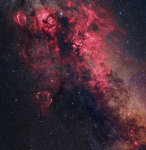 Cygnus Skyscape
25.07.2019
In brush strokes of interstellar dust and glowing hydrogen gas, this beautiful skyscape is painted across the plane of our Milky Way Galaxy near the northern end of the Great Rift and the constellation Cygnus the Swan.
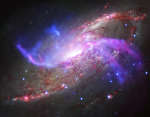 M106 Across the Spectrum
5.07.2014
The spiral arms of bright, active galaxy M106 sprawl through this remarkable multiwavelength portrait, composed of image data from radio to X-rays, across the electromagnetic spectrum. Also known as NGC 4258, M106 can be found toward the northern constellation Canes Venatici.
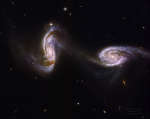 Arp 240: A Bridge between Spiral Galaxies from Hubble
28.11.2016
Why is there a bridge between these two spiral galaxies? Made of gas and stars, the bridge provides strong evidence that these two immense star systems have passed close to each other and experienced violent tides induced by mutual gravity.
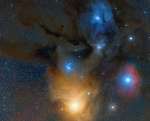 Comet Clark is near the Edge.
27.05.2017
Sweeping through this stunning field of view, Comet 71P/Clark really is in the foreground of these cosmic clouds. The 2 panel telescopic mosaic is color enhanced and is about 5 degrees (10 full moons) across.
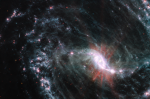 Barred Spiral Galaxy NGC 1365 from Webb
18.02.2023
A mere 56 million light-years distant toward the southern constellation Fornax, NGC 1365 is an enormous barred spiral galaxy about 200,000 light-years in diameter. That's twice the size of our own barred spiral Milky Way.
 Unwinding M51
6.04.2024
The arms of a grand design spiral galaxy 60,000 light-years across are unwound in this digital transformation of the magnificent 2005 Hubble Space Telescope portrait of M51. In fact...
|
January February March April May June July August September October |
|||||||||||||||||||||||||||||||||||||||||||||||||