
|
You entered: constellation
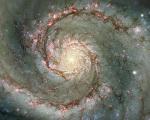 M51: The Whirlpool Galaxy in Dust and Stars
19.02.2006
The Whirlpool Galaxy is a classic spiral galaxy. At only 30 million light years distant and fully 60 thousand light years across, M51, also known as NGC 5194, is one of the brightest and most picturesque galaxies on the sky.
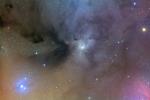 IC 4603: Reflection Nebula in Ophiuchius
4.06.2007
Why does this starfield photograph resemble an impressionistic painting? The effect is created not by digital trickery but by large amounts of interstellar dust. Dust, minute globs rich in carbon and similar in size to cigarette smoke, frequently starts in the outer atmospheres of large, cool, young stars.
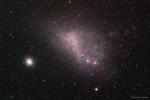 APOD: 2007 October 1- The Small Cloud of Magellan
1.10.2007
Portuguese navigator Ferdinand Magellan and his crew had plenty of time to study the southern sky during the first circumnavigation of planet Earth. As a result, two celestial wonders easily visible for southern hemisphere skygazers are known as the Clouds of Magellan.
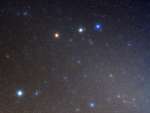 Stars and Mars
10.05.2008
Wandering through the evening sky, on May 4th planet Mars stood in line with Castor and Pollux, the two bright stars of the constellation Gemini. In this time exposure of the celestial alignment, Mars...
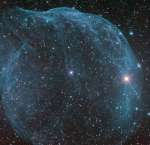 Sharpless 308
23.04.2009
Blown by fast winds from a hot, massive star, this cosmic bubble is huge. Cataloged as Sharpless 308 it lies some 5,200 light-years away in the constellation Canis Major and covers over 2/3 degree on the sky (compared with 1/2 degree for the Full Moon).
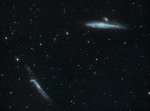 The Whale and the Hockey Stick
21.08.2009
NGC 4631 is a big beautiful spiral galaxy seen edge-on (top right) only 25 million light-years away towards the small northern constellation Canes Venatici. This galaxy's slightly distorted wedge shape suggests to some a cosmic herring and to others the popular moniker of The Whale Galaxy.
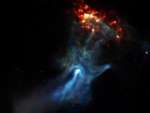 A Pulsar s Hand
1.05.2010
As far as pulsars go, PSR B1509-58 appears young. Light from the supernova explosion that gave birth to it would have first reached Earth some 1,700 years ago. The magnetized, 20 kilometer-diameter neutron star spins 7 times per second, a cosmic dynamo that powers a wind of charged particles.
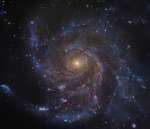 Messier 101
15.04.2011
Big, beautiful spiral galaxy M101 is one of the last entries in Charles Messier's famous catalog, but definitely not one of the least. About 170,000 light-years across, this galaxy is enormous, almost twice the size of our own Milky Way galaxy.
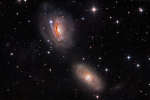 Unraveling NGC 3169
6.11.2015
Spiral galaxy NGC 3169 appears to be unraveling in this cosmic scene, played out some 70 million light-years away just below bright star Regulus toward the faint constellation Sextans. Its beautiful spiral arms...
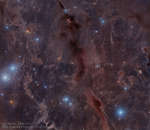 Dark Nebulas across Taurus
14.03.2016
Sometimes even the dark dust of interstellar space has a serene beauty. One such place occurs toward the constellation of Taurus. The filaments featured here can be found on the sky between the Pleiades star cluster and the California Nebula.
|
January February March April May June July August September October |
|||||||||||||||||||||||||||||||||||||||||||||||||