
|
You entered: nebula
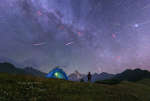 Meteors over Four Girl Mountains
13.12.2016
On some nights it rains meteors. Peaking over the next two nights, asteroid dust is expected to rain down on Earth during the annual Geminids meteor shower. This year, unfortunately, fainter Geminids will be harder to see because of the brightness of the Long Nights Full Moon, which occurs Wednesday.
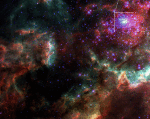 In the Center of 30 Doradus
4.10.1997
In the center of 30 Doradus lies a huge cluster of the largest, hottest, most massive stars known. The center of this cluster, known as R136, is boxed in the upper right portion of the above picture.
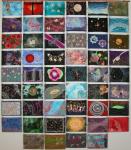 Astronomy Quilt of the Week
17.10.2003
Demonstrating her mastery of a traditional astronomical imaging technique quilter and astronomy enthusiast Judy Ross has produced this spectacular compostion of "Astronomy Quilt Piece of the Week". Her year-long effort resulted in an arrangement...
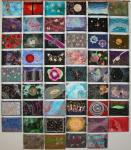 Astronomy Quilt of the Week
16.10.2005
Demonstrating her mastery of a traditional astronomical imaging technique quilter and astronomy enthusiast Judy Ross has produced this spectacular composition of "Astronomy Quilt Piece of the Week". Her year-long effort resulted in an arrangement...
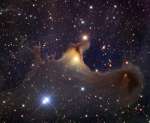 Ghost of the Cepheus Flare
31.10.2011
Spooky shapes seem to haunt this starry expanse, drifting through the night in the royal constellation Cepheus. Of course, the shapes are cosmic dust clouds faintly visible in dimly reflected starlight. Far from your...
 An Unusual Globule in IC 1396
12.12.2022
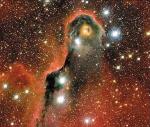
Is there a monster in IC 1396? Known to some as the Elephant's Trunk Nebula, parts of gas and dust clouds of this star formation region may appear to take on foreboding forms, some nearly human. The only real monster here, however, is a bright young star too far from Earth to hurt us.
 An Unusual Globule in IC 1396
25.03.2002
Is there a monster in IC 1396? Known to some as the Elephant's Trunk Nebula, parts of gas and dust clouds of this star formation region may appear to take on foreboding forms, some nearly human. The only real monster here, however, is a bright young star too far from Earth to hurt us.
 Still Life with NGC 2170
3.03.2005
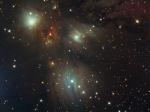
In this beautiful celestial still life composed with a cosmic brush, dusty nebula NGC 2170 shines at the upper left. Reflecting the light of nearby hot stars, NGC 2170 is joined by other bluish reflection nebulae and a compact red emission region against a backdrop of stars.
 Iguacu Starry Night
14.05.2010
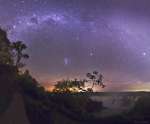
The arc of the southern Milky Way shone brightly on this starry night. Captured on May 4, in the foreground of this gorgeous skyview is the rainforest near the spectacular Iguaçu Falls and national park at the border of Brazil and Argentina.
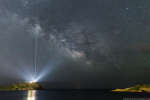 The Milky Way over the Temple of Poseidon
8.06.2015
What's that glowing in the distance? Although it may look like a lighthouse, the rays of light near the horizon actually emanate from the Temple of Poseidon at Cape Sounion, Greece. Some temple lights are even reflected in the Aegean Sea in the foreground.
|
January February March April May June July August |
||||||||||||||||||||||||||||||||||||||||||||||||||||||||