
|
You entered: stars
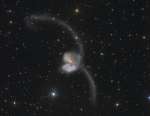 The Antennae
29.04.2011
Some 60 million light-years away in the southerly constellation Corvus, two large galaxies collided. But the stars in the two galaxies, cataloged as NGC 4038 and NGC 4039, don't collide in the course of the ponderous event, lasting hundreds of millions of years.
 Portrait of an Infant Solar System
7.06.2002
This infant solar system was discovered posing along the lonely outskirts of the Rho Ophiuchi dark cloud, a star forming region 500 light-years from Earth. Enlarged in this infrared false-color portrait from the European...
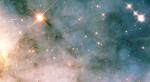 The Turbulent Neighborhood of Eta Carina
26.11.2003
How do violent stars affect their surroundings? To help find out, astronomers pointed the Hubble Space Telescope to the regions surrounding Eta Carina, a star showing signs that it may explode sometime in the next million years.
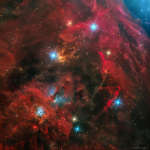 Arcs, Jets, and Shocks near NGC 1999
7.03.2018
This tantalizing array of nebulas and stars can be found about two degrees south of the famous star-forming Orion Nebula. The region abounds with energetic young stars producing jets and outflows that push through the surrounding material at speeds of hundreds of kilometers per second.
 APOD: 2025 July 22 Б A Double Detonation Supernova
22.07.2025
Can some supernovas explode twice? Yes, when the first explosion acts like a detonator for the second. This is a leading hypothesis for the cause of supernova remnant (SNR) 0509-67
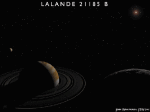 Lalande 21185: The Nearest Planetary System?
19.10.1996
What's the closest extrasolar planetary system? It may well be planets of the dim red dwarf star cataloged as Lalande 21185 -- a mere 8 light years distant. This star is too faint to be seen by the naked eye and its planets have not been imaged directly.
 APOD: 2024 May 24 Б M78 from the Euclid Space Telescope
24.05.2024
Star formation can be messy. To help find out just how messy, ESA's new Sun-orbiting Euclid telescope recently captured the most detailed image ever of the bright star forming region M78. Near...
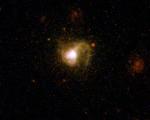 POX 186: Not So Long Ago
3.01.2003
Not so long ago and not so far, far away, a galaxy was born. Seen in this Hubble Space Telescope image, the island universe of stars, gas, and dust cataloged as POX 186 is a mere 68 million light-years distant toward an uncrowded region in the constellation Virgo.
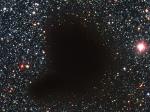 Molecular Cloud Barnard 68
9.04.2006
Where did all the stars go? What used to be considered a hole in the sky is now known to astronomers as a dark molecular cloud. Here, a high concentration of dust and molecular gas absorb practically all the visible light emitted from background stars.
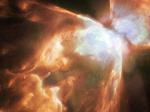 NGC 6302: Big, Bright, Bug Nebula
29.04.2007
The bright clusters and nebulae of planet Earth's night sky are often named for flowers or insects, and NGC 6302 is no exception. With an estimated surface temperature of about 250,000 degrees...
|
January February March April May June July August September October |
|||||||||||||||||||||||||||||||||||||||||||||||||