
|
You entered: Earth orbit
 Mercury: A Cratered Inferno
19.08.2001
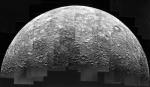
Mercury's surface looks similar to our Moon's. Each is heavily cratered and made of rock. Mercury's diameter is about 4800 km, while the Moon's is slightly less at about 3500 km (compared with about 12,700 km for the Earth). But Mercury is unique in many ways.
 Firefly Milky Way over Russia
6.09.2021
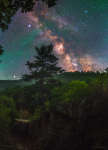
It started with a pine tree. The idea was to photograph a statuesque pine in front of the central band of our Milky Way Galaxy. And the plan, carried out two months ago, was successful -- they both appear prominently. But the resulting 3-frame panorama captured much more.
 Mercury: A Cratered Inferno
12.09.1996
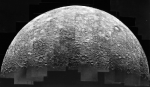
Mercury's surface looks similar to our Moon's. Each is heavily cratered and made of rock. Mercury's diameter is about 4800 km, while the Moon's is slightly less at about 3500 km (compared with about 12,700 km for the Earth). But Mercury is unique in many ways.
 Mercury: A Cratered Inferno
30.11.1997
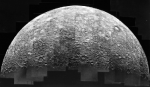
Mercury's surface looks similar to our Moon's. Each is heavily cratered and made of rock. Mercury's diameter is about 4800 km, while the Moon's is slightly less at about 3500 km (compared with about 12,700 km for the Earth). But Mercury is unique in many ways.
 COBE Dipole: Speeding Through the Universe
9.02.2003
Our Earth is not at rest. The Earth moves around the Sun. The Sun orbits the center of the Milky Way Galaxy. The Milky Way Galaxy orbits in the Local Group of Galaxies. The Local Group falls toward the Virgo Cluster of Galaxies.
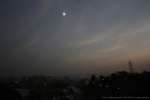 Eclipse over Chongqing, China
24.07.2009
The daytime sky grew dark, the temperature dropped, and lights came on as Chongqing, China, was plunged into the Moon's shadow during the July 22nd total solar eclipse. This serene, wide-angle view of the event looks to the east over the large, populous city from a newly constructed park.
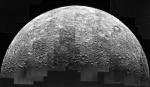 Mercury: A Cratered Inferno
2.01.1999
Mercury's surface looks similar to our Moon's. Each is heavily cratered and made of rock. Mercury's diameter is about 4800 km, while the Moon's is slightly less at about 3500 km (compared with about 12,700 km for the Earth). But Mercury is unique in many ways.
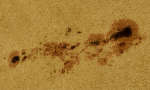 Large Sunspots Now Crossing the Sun
10.07.2013
One of the largest sunspot regions in recent years is now crossing the Sun. This region of convoluted magnetic fields may well produce a solar flare that releases a cloud of energetic particles into the Solar System.
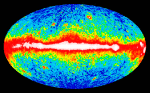 Gamma Ray Sky Map
23.06.1995
What if you could "see" gamma rays? This computer processed image represents a map of the entire sky at photon energies above 100 million electron Volts. These gamma-ray photons are more than 40 million times more energetic than visible light photons and are blocked from the Earth's surface by the atmosphere.
 Our Rotating Earth
1.07.2020
Has your world ever turned upside-down? It would happen every day if you stay fixed to the stars. Most time-lapse videos of the night sky show the stars and sky moving above a steady Earth.
|
January February March April May June July August September October |
|||||||||||||||||||||||||||||||||||||||||||||||||