
|
You entered: Ring Nebula
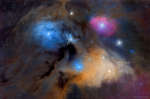 The Colorful Clouds of Rho Ophiuchi
14.10.2020
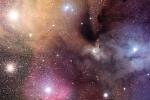
The many spectacular colors of the Rho Ophiuchi (oh'-fee-yu-kee) clouds highlight the many processes that occur there. The blue regions shine primarily by reflected light. Blue light from the Rho Ophiuchi star system and nearby stars reflects more efficiently off this portion of the nebula than red light.
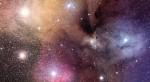 The Colorful Clouds of Rho Ophiuchi
9.07.2005
The many spectacular colors of the Rho Ophiuchi (oh'-fee-yu-kee) clouds highlight the many processes that occur there. The blue regions shine primarily by reflected light. Blue light from the star Rho Ophiuchi and nearby stars reflects more efficiently off this portion of the nebula than red light.
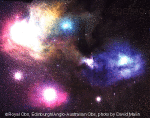 The Colorful Clouds of Rho Ophiuchi
12.03.1996
The many spectacular colors of the Rho Ophiuchi (oh'-fee-yu-kee) clouds highlight the many processes that occur there. The blue regions shine primarily by reflected light. Blue light from the star rho Ophiuchi and nearby stars reflects more efficiently off this portion of the nebula than red light.
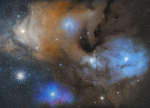 The Colorful Clouds of Rho Ophiuchi
3.12.2013
The many spectacular colors of the Rho Ophiuchi (oh'-fee-yu-kee) clouds highlight the many processes that occur there. The blue regions shine primarily by reflected light. Blue light from the star Rho Ophiuchi and nearby stars reflects more efficiently off this portion of the nebula than red light.
 The Colorful Clouds of Rho Ophiuchi
3.09.2007
The many spectacular colors of the Rho Ophiuchi (oh'-fee-yu-kee) clouds highlight the many processes that occur there. The blue regions shine primarily by reflected light. Blue light from the star Rho Ophiuchi and nearby stars reflects more efficiently off this portion of the nebula than red light.
 APOD: 2023 March 1 Б The Flaming Star Nebula
1.03.2023
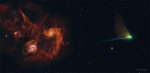
Is star AE Aurigae on fire? No. Even though AE Aurigae is named the Flaming Star and the surrounding nebula IC 405 is named the Flaming Star Nebula, and even though the nebula appears to some like a swirling flame, there is no fire.
 Roses are Red
14.02.2026
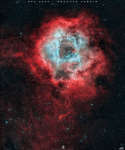
Roses are red, nebulas are too, and this Valentine's gift is a stunning view! Pictured is a loving look at the Rosette Nebula (NGC 2237): a cosmic bloom of bright young stars sitting atop a stem of glowing hot gas.
 From the Pleiades to the Eridanus Loop
23.03.2020
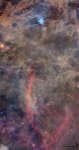
If you stare at an interesting patch of sky long enough, will it look different? In the case of Pleiades and Hyades star clusters -- and surrounding regions -- the answer is: yes, pretty different. Long...
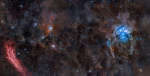 Seven Sisters Versus California
3.11.2009
On the upper right, dressed in blue, is the Pleiades. Also known as the Seven Sisters and M45, the Pleiades is one of the brightest and most easily visible open clusters on the sky. The Pleiades contains over 3,000 stars, is about 400 light years away, and only 13 light years across.
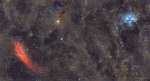 Seven Sisters versus California
5.04.2022
On the upper right, dressed in blue, is the Pleiades. Also known as the Seven Sisters and M45, the Pleiades is one of the brightest and most easily visible open clusters on the sky. The Pleiades contains over 3,000 stars, is about 400 light years away, and only 13 light years across.
|
January February March April May June July August September October |
|||||||||||||||||||||||||||||||||||||||||||||||||