
|
You entered: comet tail
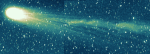 Comet Hyakutake's Past and Future
23.03.1996
The above false-color picture of Comet Hyakutake taken just two days ago shows its rapidly developing tail. The comet now has a substantial coma with a bright center, lending it a dramatic eye-like appearance. This is not Comet Hyakutake's first visit to the inner Solar System.
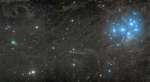 Two Comets and a Star Cluster
2.10.2017
Two unusual spots are on the move near the famous Pleiades star cluster. Shifting only a small amount per night, these spots are actually comets in our nearby Solar System that by chance wandered into the field of the light-years distant stars.
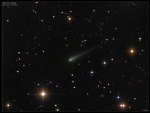 Comet ISON Approaches
7.10.2013
How impressive will Comet ISON become? No one is sure, but unfortunately, as the comet approaches the inner Solar System, it is brightening more slowly than many early predictions. Pictured above, Comet ISON is seen about two weeks ago as it continued to develop a tail.
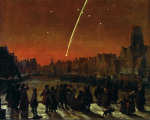 The Great Comet of 1680 Over Rotterdam
28.10.2013
Was there ever another comet like ISON? Although no two comets are exactly alike, one that appears to have had notable similarities was Comet Kirch, the Great Comet of 1680. Like approaching Comet ISON, Comet Kirch was a bright sungrazer, making a very close approach to the surface of the Sun.
 Comet SWAN Brightens
4.10.2006
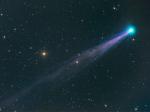
A newly discovered comet has brightened enough to be visible this week with binoculars. The picturesque comet is already becoming a favored target for northern sky imagers. Pictured above just last week, Comet SWAN showed a bright blue-green coma and an impressive tail.
 Comet Lovejoy and the ISS
31.12.2011
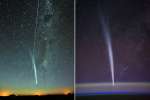
On December 24, Comet Lovejoy rose in dawn's twilight, arcing above the eastern horizon, its tails swept back by the solar wind and sunlight. Seen on the left is the comet's early morning appearance alongside the southern Milky Way from the town of Intendente Alvear, La Pampa province, Argentina.
 A Comet and a Crab
22.10.2021
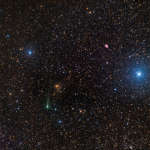
This pretty field of view spans over 2 degrees or 4 full moons on the sky, filled with stars toward the constellation Taurus, the Bull. Above and right of center in the frame you can spot the faint fuzzy reddish appearance of Messier 1 (M1), also known as the Crab Nebula.
 A Lucky Lunar Eclipse
3.04.1996
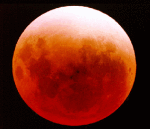
Tonight's full moon would normally washout the spectacle of Comet Hyakutake's lovely tail, even for those far from light polluted skies. Except that tonight comet observers are in luck - the dance of the planets calls for a total lunar eclipse! Lunar eclipses are caused when the Moon passes through the Earth's shadow.
 Sweeping Through Southern Skies
16.02.2013
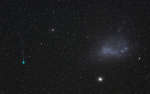
For now, Comet Lemmon (C/2012 F6a), and Comet PanSTARRS (C/2011 L4) are sweeping through southern skies. Lemmon's lime green coma and thin tail are near the left edge of this telephoto scene, a single frame from a timelapse video (vimeo here) recorded on February 12, tracking its motion against the background stars.
 Aerogel For Stardust
18.02.1999
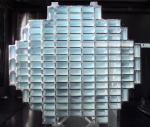
On February 7th, this honey comb of aluminum cells filled with aerogel was launched on the STARDUST mission to interplanetary space. STARDUST's goal is to capture dust from a comet's tail and return to planet Earth - the first sample return mission to a comet!
|
January February March April May June July August September |
|||||||||||||||||||||||||||||||||||||||||||||||||