
|
You entered: galactic cluster
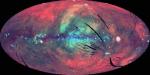 ROSAT Explores The X-Ray Sky
19.08.2000
Launched in 1990, the orbiting ROSAT observatory explored the Universe by viewing the entire sky in x-rays -- photons with about 1,000 times more energy than visible light. This ROSAT survey produced the sharpest, most sensitive image of the x-ray sky to date.
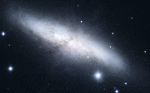 Unusual M82: The Cigar Galaxy
15.03.1998
Something strange happened to this galaxy, but what? M82 is a nearby galaxy in the group of galaxies dominated by itself, M81, and NGC 3077. M82 is thought by some to be limping away from a close encounter with M81.
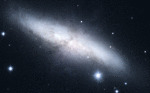 Unusual M82: The Cigar Galaxy
18.11.1996
Something strange happened to this galaxy, but what? M82 is a nearby galaxy in the group of galaxies dominated by itself, M81, and NGC 3077. M82 is thought by some to be limping away from a close encounter with M81.
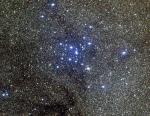 The M7 Open Star Cluster in Scorpius
5.05.2002
M7 is one of the most prominent open clusters of stars on the sky. The cluster, dominated by bright blue stars, can be seen with the naked eye in a dark sky in the tail of the constellation of Scorpius.
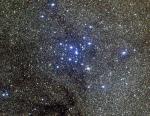 The M7 Open Star Cluster in Scorpius
22.02.2004
M7 is one of the most prominent open clusters of stars on the sky. The cluster, dominated by bright blue stars, can be seen with the naked eye in a dark sky in the tail of the constellation of Scorpius.
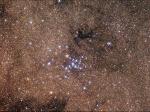 The M7 Open Star Cluster in Scorpius
6.04.2005
M7 is one of the most prominent open clusters of stars on the sky. The cluster, dominated by bright blue stars, can be seen with the naked eye in a dark sky in the tail of the constellation of Scorpius.
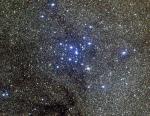 The M7 Open Star Cluster in Scorpius
5.04.2000
M7 is one of the most prominent open clusters of stars on the sky. The cluster, dominated by bright blue stars, can be seen with the naked eye in a dark sky in the tail of the constellation of Scorpius.
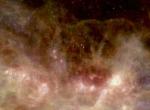 The W4 Chimney
7.02.2000
A huge chimney venting hot clouds of gas out from the plane of our Milky Way Galaxy has recently been imaged in radio waves. The Canadian Galactic Plane Survey team used an array of radio telescopes to survey an ionized gas region known as W4.
 Dark River Wide Field
19.07.2010
A Dark River of dust seems to run from our Galactic Center, then pool into a starfield containing photogenic sky wonders. Scrolling right will reveal many of these objects including (can you find?)...
 M7: Open Star Cluster in Scorpius
13.07.2016
M7 is one of the most prominent open clusters of stars on the sky. The cluster, dominated by bright blue stars, can be seen with the naked eye in a dark sky in the tail of the constellation of the Scorpion (Scorpius).
|
January February March April May June July August September October |
|||||||||||||||||||||||||||||||||||||||||||||||||