
|
You entered: halo
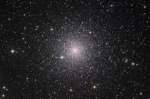 Globular Star Cluster NGC 6752
5.07.2013
Some 13,000 light-years away toward the southern constellation Pavo, the globular star cluster NGC 6752 roams the halo of our Milky Way galaxy. Over 10 billion years old, NGC 6752 follows clusters Omega Centauri and 47 Tucanae as the third brightest globular in planet Earth's night sky.
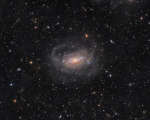 Curly Spiral Galaxy M63
4.12.2020
A bright spiral galaxy of the northern sky, Messier 63 is nearby, about 30 million light-years distant toward the loyal constellation Canes Venatici. Also cataloged as NGC 5055, the majestic island universe is nearly 100,000 light-years across, about the size of our own Milky Way.
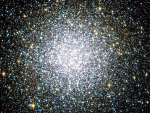 APOD: 2008 April 2- Globular Cluster M55 from CFHT
2.04.2008
The fifty-fifth entry in Charles Messier's catalog, M55 is a large and lovely globular cluster of around 100,000 stars. Only 20,000 light-years away in the constellation Sagittarius, M55 appears to earth-bound observers to be nearly 2/3 the size of the full moon.
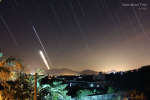 A Fading Moonset Over Hong Kong
15.12.2009
Do stars appear dimmer when nearer the horizon? Yes -- atmospheric air absorbs and reradiates light, so that the greater the airmass through which one peers, the fainter an object will appear. Pictured above in a multi-frame image, stars, the planet Jupiter, and even the Moon show the horizon-dimming effects of Earth's nearly-transparent atmosphere.
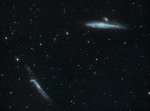 The Whale and the Hockey Stick
21.08.2009
NGC 4631 is a big beautiful spiral galaxy seen edge-on (top right) only 25 million light-years away towards the small northern constellation Canes Venatici. This galaxy's slightly distorted wedge shape suggests to some a cosmic herring and to others the popular moniker of The Whale Galaxy.
 M15: Dense Globular Star Cluster
15.06.2023
Messier 15 is an immense swarm of over 100,000 stars. A 13 billion year old relic of the early formative years of our galaxy it's one of about 170 globular star clusters that still roam the halo of the Milky Way.
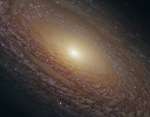 Spiral Galaxy NGC 2841 Close Up
19.02.2011
A mere 46 million light-years distant, spiral galaxy NGC 2841 can be found in the northern constellation of Ursa Major. This sharp view of the gorgeous island universe shows off a striking yellow nucleus and galactic disk.
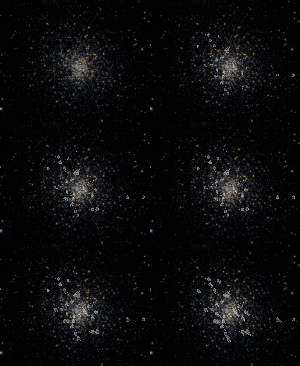 The Gaia Stars of M15
28.03.2019
Messier 15 is a 13 billion year old relic of the early formative years of our galaxy, one of about 170 globular star clusters that still roam the halo of the Milky Way. About 200 light-years in diameter, it lies about 35,000 light years away toward the constellation Pegasus.
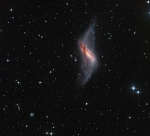 Polar Ring Galaxy NGC 660
17.02.2017
NGC 660 is featured in this cosmic snapshot. Over 40 million light-years away and swimming within the boundaries of the constellation Pisces, NGC 660's peculiar appearance marks it as a polar ring galaxy.
 Spiral Galaxy NGC 2841
23.03.2023
A mere 46 million light-years distant, spiral galaxy NGC 2841 can be found in planet Earth's night sky toward the northern constellation of Ursa Major. This sharp image centered on the gorgeous island universe also captures spiky foreground Milky Way stars and more distant background galaxies within the same telescopic field of view.
|
January February March April May June July August September October |
|||||||||||||||||||||||||||||||||||||||||||||||||