
|
You entered: jet
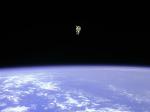 To Fly Free in Space
16.09.2007
At about 100 meters from the cargo bay of the space shuttle Challenger, Bruce McCandless II was further out than anyone had ever been before. Guided by a Manned Maneuvering Unit (MMU), astronaut McCandless, pictured above, was floating free in space.
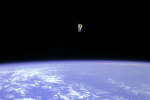 To Fly Free in Space
27.09.2009
At about 100 meters from the cargo bay of the space shuttle Challenger, Bruce McCandless II was further out than anyone had ever been before. Guided by a Manned Maneuvering Unit (MMU), astronaut McCandless, pictured above, was floating free in space.
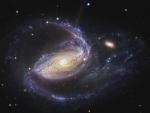 In the Arms of NGC 1097
1.12.2006
A smaller companion seems wrapped in the spiral arms of enigmatic galaxy NGC 1097. This amazingly deep image of the peculiar spiral system, also known as Arp 77, actually combines data from two telescopes, one in the northern and one in the southern hemisphere of planet Earth.
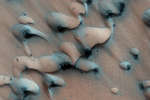 Sand Dunes Thawing on Mars
3.03.2008
What are these strange shapes on Mars? Defrosting sand dunes. As spring now dawns on the Northern Hemisphere of Mars, dunes of sand near the pole, as pictured above, are beginning to thaw. The carbon dioxide and water ice actually sublime in the thin atmosphere directly to gas.
 An Unusual Globule in IC 1396
12.12.2022
Is there a monster in IC 1396? Known to some as the Elephant's Trunk Nebula, parts of gas and dust clouds of this star formation region may appear to take on foreboding forms, some nearly human. The only real monster here, however, is a bright young star too far from Earth to hurt us.
 NGC 7009: The Saturn Nebula
30.12.1997
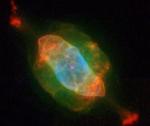
The layers of the Saturn Nebula give a complex picture of how this planetary nebula was created. The above picture, taken in April 1996 and released last week, allows a better understanding of the mysterious process that transformed a low-mass star into a white dwarf star.
 An Unusual Globule in IC 1396
25.03.2002
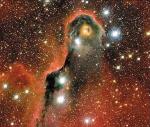
Is there a monster in IC 1396? Known to some as the Elephant's Trunk Nebula, parts of gas and dust clouds of this star formation region may appear to take on foreboding forms, some nearly human. The only real monster here, however, is a bright young star too far from Earth to hurt us.
 Micro-Quasar GRS1915 Puffs
2.12.1997
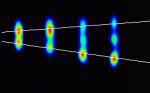
On the far side of our Galaxy, gas clouds explode away from a small black hole. This might seem peculiar, as black holes are supposed to attract matter. But material falling toward a black hole collides and heats up, creating an environment similar to a quasar that is far from stable.
 M78 Wide Field
21.01.2021
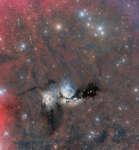
Interstellar dust clouds and glowing nebulae abound in the fertile constellation of Orion. One of the brightest, M78, is centered in this colorful, wide field view, covering an area north of Orion's belt. At a distance of about 1,500 light-years, the bluish reflection nebula is around 5 light-years across.
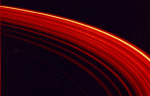 Exploring Saturn's Rings
31.07.1995
By watching a star flicker and fade as it passed behind Saturn's rings, NASA's Voyager 2 spacecraft was able explore the ring system in amazing detail. Data produced by Voyager's instruments...
|
January February March April May June July August September |
|||||||||||||||||||||||||||||||||||||||||||||||||