
|
You entered: nearby stars
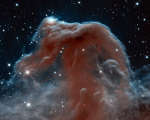 The Horsehead Nebula in Infrared from Hubble
22.04.2013
While drifting through the cosmos, a magnificent interstellar dust cloud became sculpted by stellar winds and radiation to assume a recognizable shape. Fittingly named the Horsehead Nebula, it is embedded in the vast and complex Orion Nebula (M42).
 Galactic Cirrus: Mandel Wilson 9
21.07.2023
The combined light of stars along the Milky Way are reflected by these cosmic dust clouds that soar 300 light-years or so above the plane of our galaxy. Known to some as integrated flux nebulae and commonly found at high galactic latitudes, the dusty galactic cirrus clouds are faint.
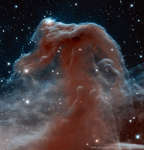 The Horsehead Nebula in Infrared from Hubble
8.06.2016
While drifting through the cosmos, a magnificent interstellar dust cloud became sculpted by stellar winds and radiation to assume a recognizable shape. Fittingly named the Horsehead Nebula, it is embedded in the vast and complex Orion Nebula (M42).
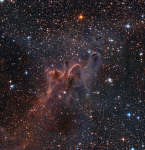 Cometary Globules
12.10.2013
Bright-rimmed, flowing shapes gather near the center of this rich starfield toward the boarders of the nautical southern constellations Pupis and Vela. Composed of interstellar gas and dust, the grouping of light-year sized cometary globules is about 1300 light-years distant.
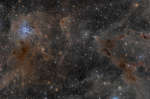 The Iris Nebula in a Field of Dust
12.09.2019
These cosmic dust clouds drift some 1,300 light-years away along the fertile starfields of the constellation Cepheus. The beautiful Iris Nebula, also known as NGC 7023, blossoms at the upper left. Not the only nebula in the sky to evoke the imagery of flowers, its pretty, symmetric form spans about 6 light-years.
 The Horsehead Nebula
27.05.2007
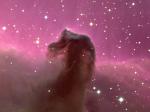
One of the most identifiable nebulae in the sky, the Horsehead Nebula in Orion, is part of a large, dark, molecular cloud. Also known as Barnard 33, the unusual shape was first discovered on a photographic plate in the late 1800s.
 Alpha Cam: Runaway Star
24.11.2006
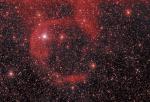
Runaway stars are massive stars traveling rapidly through interstellar space. Like a ship plowing through cosmic seas, runaway star Alpha Cam has produced this graceful arcing bow wave or bow shock - moving at over 60 kilometers per second and compressing the interstellar material in its path.
 The Horsehead Nebula
21.07.2009
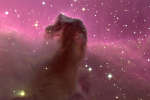
One of the most identifiable nebulae in the sky, the Horsehead Nebula in Orion, is part of a large, dark, molecular cloud. Also known as Barnard 33, the unusual shape was first discovered on a photographic plate in the late 1800s.
 The Horsehead Nebula
21.10.2012
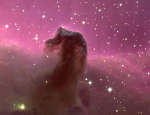
One of the most identifiable nebulae in the sky, the Horsehead Nebula in Orion, is part of a large, dark, molecular cloud. Also known as Barnard 33, the unusual shape was first discovered on a photographic plate in the late 1800s.
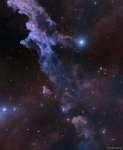 The Witch Head Nebula
31.12.2018
Double, double toil and trouble; Fire burn, and cauldron bubble .... maybe Macbeth should have consulted the Witch Head Nebula. A frighteningly shaped reflection nebula, this cosmic crone is about 800 light-years away though. Its malevolent visage seems to glare toward nearby bright star Rigel in Orion, just off the right edge of this frame.
|
January February March April May June July August |
||||||||||||||||||||||||||||||||||||||||||||||||||||||||