
|
You entered: open cluster
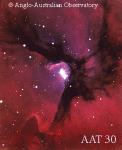 Hot Stars in the Trifid Nebula
21.12.1995
In the center of the glowing red gas on the Trifid Nebula lies an open cluster of young hot stars. The energetic light from these stars strikes hydrogen atoms in the surrounding nebula causing them to lose their electrons.
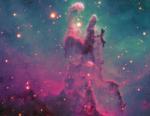 Eagle Castle
30.07.1997
What lights up this castle of star formation? The familiar Eagle Nebula glows much like a neon sign, but in many colors at once. The above photograph is a composite of three of these glowing gas colors.
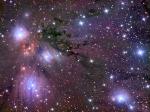 Stars, Dust and Nebula in NGC 2170
28.02.2007
When stars form, pandemonium reigns. A textbook case is the star forming region NGC 2170. Visible above are red glowing emission nebulas of hydrogen, blue reflection nebulas of dust, dark absorption nebulas of dust, and the stars that formed from them.
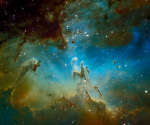 The Pillars of Eagle Castle
14.07.2013
What lights up this castle of star formation? The familiar Eagle Nebula glows bright in many colors at once. The above image is a composite of three of these glowing gas colors. Pillars of dark dust nicely outline some of the denser towers of star formation.
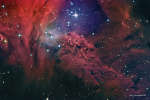 The Fox Fur Nebula
30.12.2015
This interstellar canine is formed of cosmic dust and gas interacting with the energetic light and winds from hot young stars. The shape, visual texture, and color, combine to give the region the popular name Fox Fur Nebula.
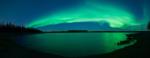 Aurora, Stars, Meteor, Lake, Alaska
9.10.2007
Sometimes, after your eyes adapt to the dark, a spectacular sky appears. In this case, a picturesque lake lies in front of you, beautiful green aurora flap high above you, brilliant stars shine far in the distance, and, for a brief moment, a bright meteor streaks by.
 M16: Stars from Eagle's EGGs
25.11.2001
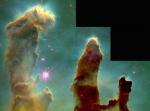
Newborn stars are forming in the Eagle Nebula. This image, taken with the Hubble Space Telescope in 1995, shows evaporating gaseous globules (EGGs) emerging from pillars of molecular hydrogen gas and dust. The giant pillars are light years in length and are so dense that interior gas contracts gravitationally to form stars.
 M16: Stars from Eagle's Eggs
24.09.2000
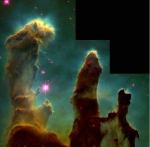
Newborn stars are forming in the Eagle Nebula. This image, taken with the Hubble Space Telescope in 1995, shows evaporating gaseous globules (EGGs) emerging from pillars of molecular hydrogen gas and dust. The giant pillars are light years in length and are so dense that
 A Close-Up of the Lagoon Nebula
20.08.1996
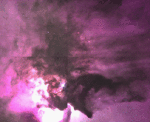
Ribbons of red-glowing gas and dark dust surround massive young stars in this close-up of the Lagoon Nebula taken by the Hubble Space Telescope. The Lagoon Nebula is relatively close and bright - it appears larger than the Full Moon and is visible even without a telescope.
 M16: Stars from Eagles EGGs
26.10.2003
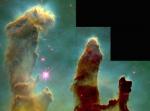
Newborn stars are forming in the Eagle Nebula. This image, taken with the Hubble Space Telescope in 1995, shows evaporating gaseous globules (EGGs) emerging from pillars of molecular hydrogen gas and dust. The giant pillars are light years in length and are so dense that interior gas contracts gravitationally to form stars.
|
January February March April May June July August September October |
|||||||||||||||||||||||||||||||||||||||||||||||||