
|
You entered: rings
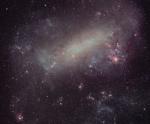 The Large Cloud of Magellan
2.09.2004
Portuguese navigator Fernando de Magellan and his crew had plenty of time to study the southern sky during the first circumnavigation of planet Earth. As a result, two fuzzy cloud-like objects easily visible for southern hemisphere skygazers are known as the Clouds of Magellan.
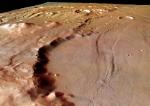 Crater Wall on Solis Planum
30.09.2004
This dramatic perspective view looks south-east along the wall of a large eroded impact crater on Solis Planum, bordering the mountainous Thaumasia region of Mars. Stretching for about 50 kilometers into the scene, the crater wall is around 800 meters high.
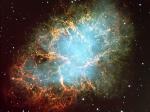 The Crab Nebula from VLT
22.11.1999
The Crab Nebula, filled with mysterious filaments, is the result of a star that was seen to explode in 1054 AD. This spectacular supernova explosion was recorded by Chinese and (quite probably) Anasazi Indian astronomers.
 IC 1396 and Surrounding Starfield
19.08.2009
Sprawling across hundreds of light-years, emission nebula IC 1396, visible on the upper right, mixes glowing cosmic gas and dark dust clouds. Stars are forming in this area, only about 3,000 light-years from Earth. This wide angle view also captures surrounding emission and absorption nebula.
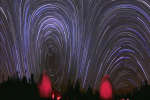 Warped Sky: Star Trails Panorama
11.07.2010
What's happened to the sky? A time warp, of sorts, and a digital space warp too. The time warp occurs because this image captured in a single frame a four hour exposure of the night sky. As a result, prominent star trails are visible.
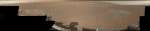 The First Color Panorama from Mars by Curiosity
11.08.2012
You've just landed on Mars and opened your eyes -- what do you see? If you're the Curiosity rover, you see a strange gravelly place with a large mountain in the distance.
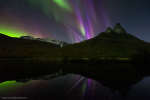 Aurora and Fireball Over Norway
5.10.2012
What's happening behind that mountain? A convergence of variable sky spectacles. One night in mid-September near TromsЬ, Norway, high red aurora could be seen shimmering through lower green aurora in a way that created a striking and somewhat unusual violet glow.
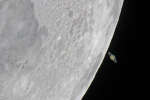 The Moons Saturn
7.04.2013
Just days after sharing the western evening sky with Venus in 2007, the Moon moved on to Saturn - actually passing in front of the ringed planet Saturn when viewed in skies over Europe, northern Africa, and western Asia.
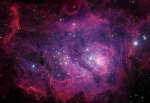 The Wide and Deep Lagoon
9.09.2016
Ridges of glowing interstellar gas and dark dust clouds inhabit the turbulent, cosmic depths of the Lagoon Nebula. Also known as M8, the bright star forming region is about 5,000 light-years distant.
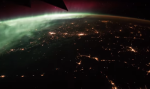 Flying over the Earth at Night II
12.03.2018
What would it be like to orbit the Earth? The International Space Station (ISS) does this every 90 minutes, and sometimes the astronauts on board take image sequences that are made into videos. The featured time-lapse video shows many visual spectacles of the dark Earth below.
|
January February March April May June July August September October |
|||||||||||||||||||||||||||||||||||||||||||||||||