
|
You entered: apod
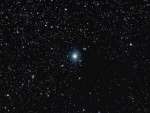 The Mystery of the Fading Star
8.01.2010
Every 27 years Epsilon Aurigae fades, remaining dim for roughly two years before growing bright again. Since the 19th century, astronomers have studied the mystery star, eventually arguing that Epsilon Aur, centered in this telescopic skyview, was actually undergoing a long eclipse by a dark companion object.
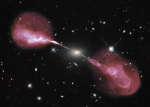 Plasma Jets from Radio Galaxy Hercules A
5.12.2012
Why does this galaxy emit such spectacular jets? No one is sure, but it is likely related to an active supermassive black hole at its center. The galaxy at the image center, Hercules A, appears to be a relatively normal elliptical galaxy in visible light.
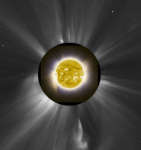 An Active Sun During a Total Eclipse
11.11.2013
Sometimes, a total eclipse of the Sun is an opportunity. Taking advantage of such, the above image shows the solar eclipse earlier this month as covered and uncovered by several different solar observatories.
 WR 104: A Pinwheel Star System
3.06.2014
Might this giant pinwheel one-day destroy us? Probably not, but investigation of the unusual star system Wolf-Rayet 104 has turned up an unexpected threat. The unusual pinwheel pattern has been found to be created by energetic winds of gas and dust that are expelled and intertwine as two massive stars orbit each other.
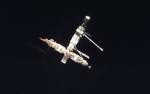 Atlantis Approaches Mir
2.04.1996
Imagine flying though space and approaching the Mir space station. The crew of the Space Shuttle Atlantis did just this in a mission that ended only two days ago. Mir, now 10 years old, is equipped for scientific experiments in astronomy, physics, materials, biology and chemistry.
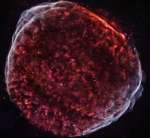 X rays from Supernova Remnant SN 1006
23.04.2013
What looks like a puff-ball is surely the remains of the brightest supernova in recorded human history. In 1006 AD, it was recorded as lighting up the nighttime skies above areas now known as China, Egypt, Iraq, Italy, Japan, and Switzerland.
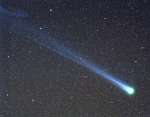 Comet Hyakutake Passes the Earth
16.12.2009
In 1996, an unexpectedly bright comet passed by planet Earth. Discovered less than two months before, Comet C/1996 B2 Hyakutake came within only 1/10th of the Earth-Sun distance from the Earth in late March.
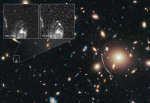 Galaxy Cluster Magnifies Distant Supernova
5.05.2014
How do you calibrate a huge gravitational lens? In this case the lens is the galaxy cluster Abell 383, a massive conglomeration of galaxies, hot gas, and dark matter that lies about 2.5 billion light years away (redshift z=0.187).
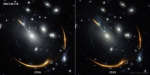 SN Requiem: A Supernova Seen Three Times So Far
2.11.2021
We've seen this same supernova three times -- when will we see it a fourth? When a distant star explodes in a supernova, we're lucky if we see it even once.
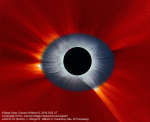 Combined Solar Eclipse Corona from Earth and Space
12.04.2016
Sometimes, a total eclipse is a good time to eye the Sun. Taking advantage of an unusual juxtaposition of Earth, Moon and Sun, the featured image depicts the total solar eclipse that occurred last month as it appeared -- nearly simultaneously -- from both Earth and space.
|
January February March April May June July August September |
|||||||||||||||||||||||||||||||||||||||||||||||||