
|
You entered: image
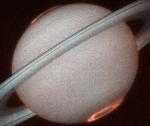 Saturnian Aurora
23.12.2001
the second largest planet in the Solar System, Saturn's Rings are one of the most spectacular sights for earthbound telescopes. This image from the orbiting Hubble Space Telescope's STIS instrument, offers a striking view of another kind of ring around Saturn - pole encircling rings of ultraviolet aurora.
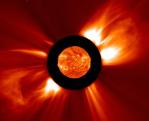 Double Trouble Solar Bubbles
16.05.2002
During April and May, attention has been focused on the western evening sky, presenting its spectacle of bright planets and crescent moons shortly after sunset. Meanwhile, the Sun itself has not been just sinking quietly below the horizon.
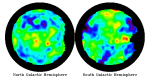 COBE Hotspots:The Oldest Structures Known
9.03.1997
Above are two images of the microwave sky, north and south of our galaxy's equator, based on data from NASA's COsmic Background Explorer (COBE) satellite. After computer processing to remove contributions from nearby objects and the effects of the earth's motion, they show "spots".
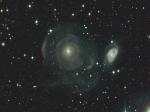 Galaxy NGC 474: Cosmic Blender
8.10.2007
What's happening to galaxy NGC 474? The multiple layers of emission appear strangely complex and unexpected given the relatively featureless appearance of the elliptical galaxy in less deep images. The cause...
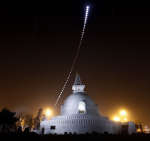 A Lunar Eclipse Over an Indian Peace Pagoda
14.12.2011
Our Moon turned red last week. The reason was that during December 10, a total lunar eclipse occurred. The above digitally superimposed image mosaic captured the Moon many times during the eclipse, from before the Moon entered Earth's shadow until after the Moon exited.
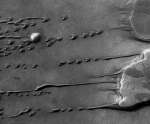 Flowing Barchan Sand Dunes on Mars
22.04.2012
When does Mars act like a liquid? Although liquids freeze and evaporate quickly into the thin atmosphere of Mars, persistent winds may make large sand dunes appear to flow and even drip like a liquid.
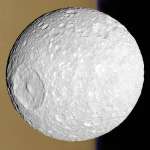 Mimas: Small Moon with a Big Crater
21.10.2014
Whatever hit Mimas nearly destroyed it. What remains is one of the largest impact craters on one of Saturn's smallest moons. The crater, named Herschel after the 1789 discoverer of Mimas, Sir William Herschel, spans about 130 kilometers and is pictured above.
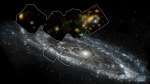 High Energy Andromeda
7.01.2016
A mere 2.5 million light-years away, the Andromeda Galaxy, also known as M31, really is just next door as large galaxies go. In this (inset) scan, image data from NASA's Nuclear Spectrosopic Telescope...
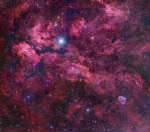 Central Cygnus Skyscape
22.03.2017
In cosmic brush strokes of glowing hydrogen gas, this beautiful skyscape unfolds across the plane of our Milky Way Galaxy near the northern end of the Great Rift and the center of the constellation Cygnus the Swan. A 36 panel mosaic of telescopic image data, the scene spans about six degrees.
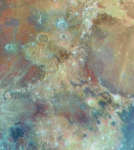 A Colourful Moon
11.11.2017
The Moon is normally seen in subtle shades of grey. But small, measurable color differences have been greatly exaggerated in this mosaic of high-resolution images captured near the Moon's full phase, to construct a multicolored, central moonscape.
|
January February March April May June July August September |
|||||||||||||||||||||||||||||||||||||||||||||||||