
|
You entered: nebula
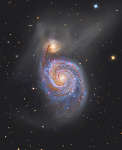 M51: The Whirlpool Galaxy
2.06.2012
Follow the handle of the Big Dipper away from the dipper's bowl until you get to the handle's last bright star. Then, just slide your telescope a little south and west and you might find this stunning pair of interacting galaxies, the 51st entry in Charles Messier famous catalog.
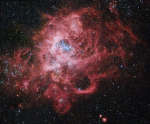 NGC 604: Giant Stellar Nursery
11.12.2012
Stars are sometimes born in the midst of chaos. About 3 million years ago in the nearby galaxy M33, a large cloud of gas spawned dense internal knots which gravitationally collapsed to form stars. NGC 604 was so large, however, it could form enough stars to make a globular cluster.
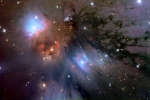 Still Life with Reflecting Dust
4.03.2017
In this beautiful celestial still life composed with a cosmic brush, dusty nebula NGC 2170 shines at the upper left. Reflecting the light of nearby hot stars, NGC 2170 is joined by other bluish reflection nebulae, a compact red emission region, and streamers of obscuring dust against a backdrop of stars.
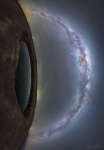 Eye on the Milky Way
21.04.2020
Have you ever had stars in your eyes? It appears that the eye on the left does, and moreover it appears to be gazing at even more stars. The featured 27-frame mosaic was taken last July from Ojas de Salar in the Atacama Desert of Chile.
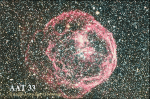 Henize 70: A SuperBubble In The LMC
10.05.1996
Massive stars (tens of times the mass of the Sun) profoundly affect their galactic environment. Churning and mixing the clouds of gas and dust between the stars, they leave their mark in the compositions and locations of future generations of stars and star systems.
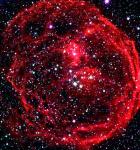 Henize 70: A Superbubble in the LMC
30.11.1999
Massive stars -- upwards of tens of times the mass of the Sun - profoundly affect their galactic environment. Churning and mixing the clouds of gas and dust between the stars, they leave their mark on the compositions and locations of future generations of stars and star systems.
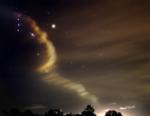 A Path To Orion
16.12.2006
Last Saturday, the Space Shuttle Discovery lit up the night as it climbed into orbit above planet Earth. From Oak Hill, Florida, USA - about 30 miles north of the Kennedy Space Center - design engineer...
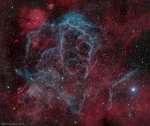 Vela Supernova Remnant
10.09.2010
The plane of our Milky Way Galaxy runs through this complex and beautiful skyscape. At the northwestern edge of the constellation Vela (the Sails) the four frame mosaic is over 10 degrees wide, centered on the glowing filaments of the Vela Supernova Remnant, the expanding debris cloud from the death explosion of a massive star.
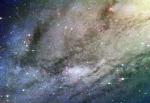 Southwest Andromeda
17.09.2001
This new image composite of the southwest region of M31 from the Subaru Telescope shows many stars, nebulae, and star clusters never before resolved. An older population of stars near Andromeda's center causes the yellow hue visible on the upper right. Young blue stars stand out in the spiral arms on the lower left.
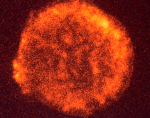 Tycho's Supernova Remnant in X-ray
23.06.1996
How often do stars explode? By looking at external galaxies, astronomers can guess that these events, known as a supernovae, should occur about once every 30 years in a typical spiral galaxy like our MilkyWay.
|
January February March April May June July August |
||||||||||||||||||||||||||||||||||||||||||||||||||||||||