
|
You entered: Moon
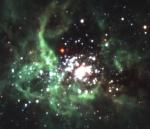 Tarantula
4.06.1997
NGC 2070 is an immense star forming region in a nearby galaxy known as the Large Magellanic Cloud. Its spidery appearance is responsible for its popular name, "The Tarantula Nebula", except that this tarantula is about 1,000 light-years across, and 165,000 light-years away in the southern constellation Dorado.
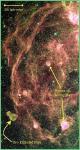 Stellar Laboratories in the LMC
25.07.1997
Stars are evolving in the Large Magellanic Clouds (LMC). This is particularly evident in the above close-up of the LMC's edge, which appears about as large as the full moon. Visible only...
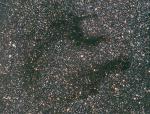 The E Nebula in Aquila
20.08.2003
Several unusual strands of darkness are prominent toward the constellation of Aquila. This particular dark nebula is known as the E Nebula, for its evocative shape, or B142 and B143, for its position(s) on a list of such nebula compiled by Barnard.
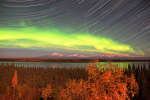 Aurora Over Alaska
6.10.2010
Are those green clouds or aurora? Photographed above two weeks ago, puffy green aurora help the Moon illuminate the serene Willow Lake and the snowy Wrangell and Saint Elias Mountains in eastern Alaska, USA.
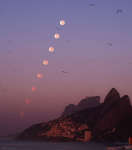 Rio Morning Moonset
20.04.2011
As the Sun rose, a nearly full Moon set in this serene seaside vista captured last Monday from Rio de Janeiro, Brazil. In the foreground, the reddened early morning sunlight illuminates a stretch of South Atlantic coastline.
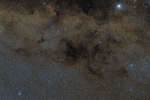 Rigil Kentaurus and Sandqvist 169
13.04.2019
Rigil Kentaurus is the bright star near the top of this broad southern skyscape. Of course it's probably better known as Alpha Centauri, nearest star system to the Sun. Below it sprawls a dark nebula complex.
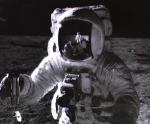 Apollo 12: Self-Portrait
9.05.1997
Is it art? In November of 1969, Apollo 12 astronaut-photographer Charles "Pete" Conrad recorded this masterpiece while documenting colleague Alan Bean's lunar soil collection activities on the Oceanus Procellarum. The image is dramatic and stark.
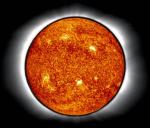 Solar Eclipse: A Composite View
27.02.1998
Yesterday, the Moon's shadow reached out and touched the Earth, treating a large portion of the Western Hemisphere to an Eclipse of the Sun. This composite image combines pictures of the Sun made from both Earth and space.
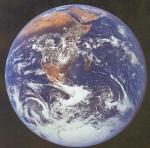 Welcome to Planet Earth
2.01.2005
Welcome to Planet Earth, the third planet from a star named the Sun. The Earth is shaped like a sphere and composed mostly of rock. Over 70 percent of the Earth's surface is water. The planet has a relatively thin atmosphere composed mostly of nitrogen and oxygen.
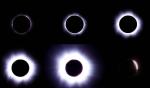 Light From The Dark Sun
19.08.1999
Only in the fleeting darkness of a total solar eclipse is the light of the solar corona easily visible from Earth. Normally overwhelmed by the bright solar disk, the expansive corona, the sun's outer atmosphere, is an alluring sight.
|
January February March April May June July August September October |
|||||||||||||||||||||||||||||||||||||||||||||||||